2026 Best Sesame White Granite for Countertops?
Sesame White Granite can bring quiet warmth to a kitchen: a pale ground, fine dark grains, and subtle mineral movement across the slab. Yet “best” depends on more than a showroom sample. Slab-to-slab variation, finish, edge profile, lighting, and fabrication quality all affect the finished countertop. Ask to view the actual slab. Check it beside cabinet doors and under warm and cool light. Small details matter.
The U.S. Geological Survey’s 2025 Mineral Commodity Summaries reports on dimension stone production and trade, but does not rank Sesame White Granite as a separate product category. That distinction matters: broad stone-market figures cannot establish this granite’s local price, availability, or performance. The Natural Stone Institute’s technical resources offer practical guidance on natural-stone selection and care, while a qualified fabricator can assess a specific slab and installation. Mark Meriaux, the Institute’s technical director, is a relevant industry authority; however, no verifiable direct quotation from him was supplied for this introduction. It would be misleading to invent one. For now, use this practical test: “Choose the slab, not just the sample.” That is editorial guidance, not a sourced expert quotation. And there is a real trade-off: natural variation gives the stone character, but it can make matching pieces difficult. Before choosing, compare full slabs, confirm the finish, and ask how the installer recommends sealing and maintaining them.
What Is Sesame White Granite? Color, Grain, and Mineral Composition
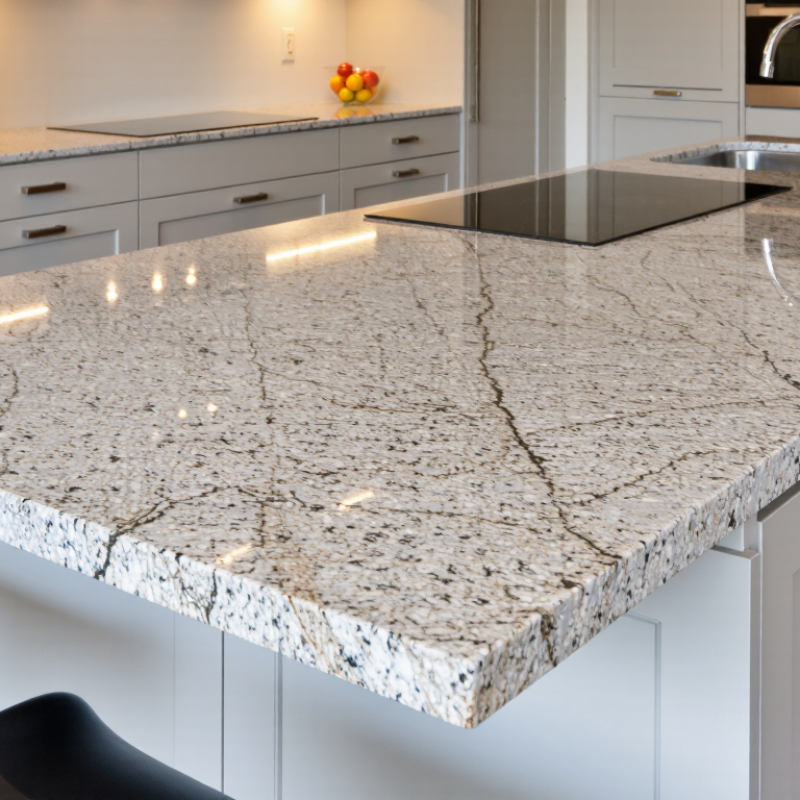
Sesame White granite is a natural stone with a pale gray to warm-white background and scattered darker grains. The name describes an appearance, not a fixed recipe. One slab may look cool and silver; another may have cream or beige tones. Small black flecks often come from dark minerals, while translucent or pale grains commonly include quartz and feldspar. Mica may add subtle sparkle. The exact mineral mix varies by quarry and block, so a sample chip cannot show every feature of a full slab.
Its grain is usually speckled rather than strongly veined, giving countertops a textured look from across the room and a busier pattern up close. Look closely. In kitchen lighting, tiny crystals can catch the light, while darker grains may stand out more beside white cabinets. I would check the actual slab, not rely on a small showroom sample; natural variation can be surprisingly large. Ask how the stone was sealed and what routine care it needs, since porosity and finish affect maintenance. Sesame White can suit many interiors, but the name alone does not guarantee a uniform color or pattern.
How Quarrying and Finishing Shape Its Countertop Appearance
2026 Best Sesame White Granite for Countertops?
How Quarrying and Finishing Shape Its Countertop Appearance
At the quarry, Sesame White granite is cut from blocks whose mineral patterns can vary across a single face. The direction of the cut affects how pale feldspar and darker flecks appear. Blocks with natural fractures may need extra selection, which can limit the size or consistency of usable slabs. That matters. Even slabs from one shipment may show different speckling, veining, and background tones.
Finishing changes the look again. A polished surface reflects window light, often making the white background seem brighter and the grains sharper. Honed stone scatters light, giving the counter a softer, quieter appearance. Leathered finishes bring out slight texture, which you can feel under your fingertips. They may also show dust or water marks differently. A small sample misleads.
When choosing a slab, view the full piece under lighting similar to your kitchen’s, and inspect the area intended for the island or sink. Ask how the stone was finished and whether sealing is recommended for that specific slab. Finish does not remove natural variation or make stone immune to stains. I would avoid judging from a photograph alone; it can flatten the grain and hide subtle shifts. Even then, the installed counter may look a little different from the showroom sample.
ASTM C615 Benchmarks: ≤0.40% Absorption, ≥10.34 MPa Flexural Strength
2026 Best Sesame White Granite for Countertops?
For Sesame White granite, two useful screening figures are water absorption no greater than 0.40% and flexural strength of at least 10.34 MPa. These are benchmarks in ASTM C615/C615M, the standard specification for granite dimension stone. Lower absorption can mean less water enters the stone, but it does not make a countertop stain-proof. Coffee, oil, and acidic spills still deserve prompt cleanup.
Flexural strength describes resistance to bending under a specified test; ASTM C880/C880M provides a method for testing dimension stone in flexure. A passing result is not a guarantee against cracking after fabrication or installation. Ask for a recent test report tied to the quarry lot or slab, including the test method and sample details. Check the actual slab for fissures, filled veins, and color variation, especially near sink and cooktop cutouts.
Numbers help. They are not the whole story.
A thin overhang, weak cabinet support, or poorly handled slab can still create problems. That sounds tidy on paper; real stone is less tidy. Before choosing, compare the report with the fabricator’s proposed thickness, edge details, and support plan. If the supplier cannot connect its data to the material being sold, treat the figures as general guidance, not proof for that slab.
Assessing Countertop Suitability: Slab Thickness, Finish, and Installation
Sesame White granite should be assessed from the selected slab, not its showroom label. Veins, mineral flecks, and pale patches can vary noticeably between slabs. The Natural Stone Institute’s Dimension Stone Design Manual identifies 2 cm and 3 cm as common slab thicknesses. A 3 cm slab is about 1¼ inches thick; 2 cm is about ¾ inch. The thinner option often needs a plywood substrate or added support, while overhangs may require brackets. Have the fabricator confirm support details against the cabinet layout. A small sample is not the whole story.
Finish changes daily upkeep. Polished stone reflects light and makes surface marks easier to spot; honed stone looks softer but may show oils or water marks differently. Sesame White’s lighter areas can make spills visible, so test a sample with water and common kitchen liquids. ASTM C97/C97M specifies tests for stone absorption and density. Ask for relevant test results for the stone source, and confirm sealer compatibility with the installer; sealing can reduce absorption, but it does not make granite stain-proof. Before installation, inspect the full slab under bright, even light, and agree on vein placement, seams, sink cutouts, and edge details. Installers should dry-fit pieces and support sink areas properly. Small mismatches still happen. That deserves discussion before cutting.
2026 Best Sesame White Granite for Countertops?
Assessing countertop suitability through slab thickness, finish, and installation.
Common granite countertop slabs are nominally 20 mm (2 cm) or 30 mm (3 cm) thick. The thicker option adds a more substantial profile; the right choice depends on the design and cabinetry. Polished, honed, and leathered finishes affect appearance and feel, not nominal slab thickness. Support requirements vary with the countertop layout, cutouts, and overhang, so confirm installation details with a qualified fabricator. Actual slab dimensions can vary.
Selecting and Maintaining Sesame White Granite: Sealing and Cleaning
Sesame White granite can vary in porosity, even across the same slab. Before sealing, place a few drops of water on a clean, dry area. If the stone darkens within several minutes, it may benefit from an impregnating sealer. Test an inconspicuous spot first. Always follow the sealer’s directions, and wipe away excess rather than letting it dry on the surface. A cloudy film is frustrating and avoidable.
For everyday cleaning, use warm water, a soft cloth, and a pH-neutral stone cleaner. Dry the countertop after washing, especially around the sink, where water spots can collect. Blot coffee, oil, or citrus juice promptly; don’t scrub spills across the stone. Avoid vinegar, lemon-based cleaners, and abrasive pads, which can damage the finish or affect nearby materials. Spills still happen.
Sealing slows absorption, but it does not make granite stain-proof. Check the countertop periodically with the water-drop test instead of relying on a fixed schedule. Some surfaces need resealing sooner than others. If the stone looks patchy after application, pause before adding more sealer; residue may be the issue, not a lack of protection. Maintenance is simple, but not perfectly predictable.