
A car’s cabin is small, so the right Car Aroma Diffuser should feel subtle, steady, and easy to manage. But “best” depends on your vehicle, scent preference, and tolerance for maintenance. A vent-clip diffuser sits near the airflow and is simple to install. A waterless nebulizing model can offer stronger fragrance, though its output may feel intense in a compact car. Passive wooden or felt diffusers need no power, but their scent can fade quickly. Small details matter: a warm dashboard, a closed window, or a long commute can change how fragrance feels.
Sensory psychologist Rachel Herz’s research explores how smell connects with emotion and memory. Applying that insight to car use, this guide follows a practical principle: “A good cabin scent should support the drive, not compete with it.” That is a testing principle, not a direct quotation from Herz. We compare diffuser types by scent control, upkeep, portability, and how evenly they fragrance a cabin. We also note where evidence is limited: personal sensitivity varies, and a scent that feels gentle to one passenger may distract another. Start lightly. Check the intensity after a short drive. The best choice is not always the strongest or most expensive; it is the one that remains comfortable on an ordinary trip.
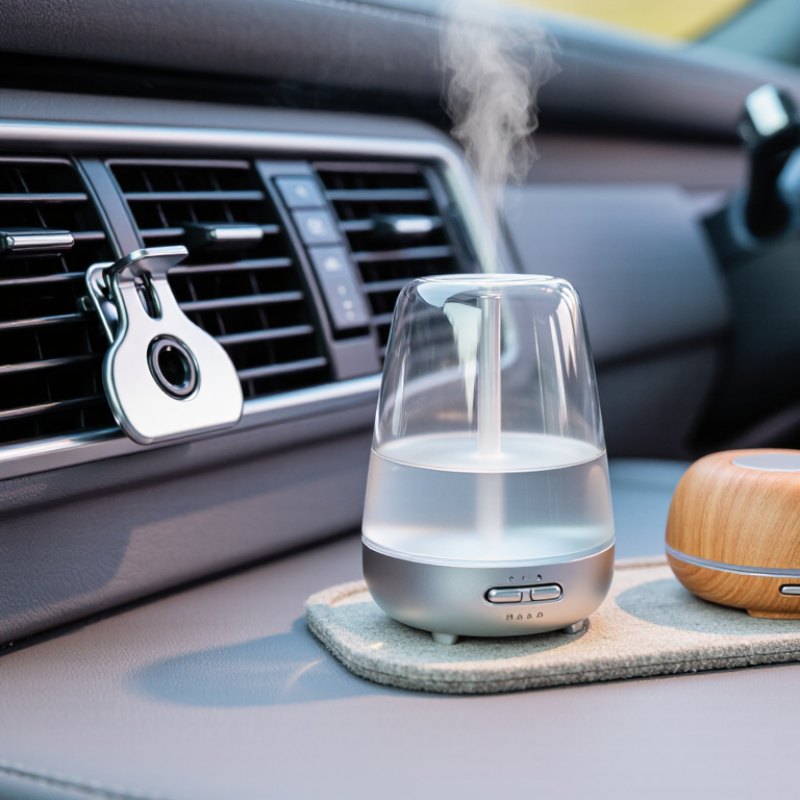
A car aroma diffuser works by moving fragrance molecules from a scented material into cabin air. In a passive model, liquid or a porous pad evaporates naturally. A vent-mounted fan speeds that process by pushing air across the scented surface. Heat can increase evaporation, while an ultrasonic device uses vibration to disperse tiny droplets. These methods feel similar, but they release fragrance differently.
The mechanism affects how quickly scent spreads and fades. A vent fan may give a stronger burst when the blower runs, then little scent when it stops. Passive pads are quieter, though their output can be uneven. Ultrasonic units add moisture with fragrance droplets, so placement and cleaning matter. Small details count.
Air quality deserves attention, too. The U.S. Environmental Protection Agency reports that indoor VOC levels are often two to five times higher than outdoor levels, and may exceed ten times during some activities. Those figures describe indoor environments generally, not car cabins. Still, they explain why fragrance strength is not the only measure of performance. A closed vehicle has limited air volume, so use a low setting and allow fresh air in when practical. Fragrance can also mask an unpleasant odor rather than remove its source. That distinction is easy to overlook.

Car aroma diffusers release fragrance through passive evaporation or an active mechanism such as a fan, heat, or ultrasonic vibration.
How to read the chart: 1 means the feature is typical of that diffuser type; 0 means it is not part of its usual mechanism. Designs can vary. Passive vent clips use air from the vehicle vents, while powered models need electricity for their fan, heater, or ultrasonic mechanism.
Car aroma diffusers mainly use passive airflow, absorbent materials, or powered devices. Vent-clip diffusers sit near the dashboard vents. Air from the fan carries their scent through the cabin, and adjustable openings can help control its strength. No charging needed. Their output may change when the fan is off, though, and a strong fragrance can feel distracting in a small car.
Hanging diffusers use porous wood, ceramic, or felt to absorb fragrance and release it gradually. They are simple to install, but scent strength can fade unevenly as the material dries.
Powered diffusers offer more control. Some use a small fan to spread fragrance; others warm a scented pad or disperse a fine mist. Check how a device is powered and whether it needs refills, cleaning, or water. A water-based model may be less convenient on a bumpy commute.
Small, but noticeable. Placement matters: keep devices clear of airbags, controls, and the driver’s view, and avoid letting fragrance leak onto trim.
There is no universally best type; cabin size, scent sensitivity, and willingness to maintain the device all matter. I’d be cautious about assuming a more powerful diffuser is automatically better.
Car aroma diffusers vary in how widely they spread scent and how much attention they need. Vent clips use moving air, so fragrance is usually strongest near the dashboard and may fade when the fan is off. They are compact and simple to replace, though scent strength can be hard to adjust precisely. A small cabin may need very little; a larger vehicle can feel unevenly scented.
USB-powered ultrasonic diffusers can distribute fragrance more consistently when the fan is running. They need occasional water refills and cleaning to prevent residue around the reservoir. Waterless nebulizing models may deliver a stronger aroma without water, but their small tubes or nozzles can need regular wiping. In practice, coverage depends on cabin size, airflow, and where the unit sits. A diffuser tucked behind a seat may do less than expected. That is easy to overlook.
Tips: Check the care instructions before adding oils or water. Keep the device upright and clear of vents, controls, and airbag areas. Start with a low setting, then adjust after a short drive. If scent lingers too strongly, reduce output or pause use; personal comfort matters more than maximum coverage.
For safety, choose a diffuser that stays secure and does not obstruct your view, controls, or airbag area. Passive vent clips are compact, while sealed solid diffusers reduce spill risk. Avoid placing glass bottles or loose objects on the dashboard. Fragrance can also bother passengers with asthma, migraines, or scent sensitivity. A pleasant smell is not automatically a safer cabin.
The U.S. EPA’s indoor-air guidance notes that concentrations of some volatile organic compounds can be two to five times higher indoors than outdoors. This is not a car-specific measurement, but it supports using fragrance sparingly in a small cabin. The EPA also lists possible effects such as eye and throat irritation. NHTSA reported 3,308 deaths in distraction-affected crashes in 2022; that figure does not link crashes to diffusers, but adjusting one while driving is an avoidable distraction.
Tips: Install or refill the diffuser while parked. Follow its use instructions, keep liquid away from hot surfaces, and stop using it if anyone feels unwell. Open a window briefly for fresh air. Check placement again after bumps; a secure fit can still shift.
Choosing a car aroma diffuser starts with your cabin, not the scent. A vent clip needs no charging, but airflow can make fragrance stronger when the fan runs. A USB-powered unit offers adjustable output, though it adds a cable and another item to secure. A passive porous stone is simple and quiet. It may release less scent on cold days. Keep it subtle.
Check where the device sits. It should not block vents, displays, mirrors, or controls. NHTSA reported 3,308 deaths in distraction-affected crashes in 2022, a reminder to keep attention and sightlines clear. Choose a stable, leak-resistant design, especially if you brake sharply or carry loose bags. Follow the maker’s instructions, and avoid placing liquid reservoirs where they could spill onto electronics.
Scent strength matters more than fancy settings. The U.S. EPA says indoor pollutant levels can often be two to five times outdoor levels; a car is a different, smaller environment, so treat that figure as context, not a cabin measurement. A diffuser is not an air cleaner. Start with the lowest setting, use it briefly, and stop if the fragrance causes irritation. I still find intensity easy to misjudge. A short test drive helps.
Whether you’re a homeowner, builder, or designer, you’ll find that our elegant cabinets create a breathtaking space that evokes positive emotions and encourages lasting memories. We invite you to explore our website to learn more about who we are and how we can help you.
Woodinville | Bellevue | Seattle | Kirkland | California | Berkeley | Walnut Creek | Roseville, CA
© 2025 Acadia Craft. Powered by Integrity Marketing Serving Woodinville, Kirkland, Bellevue & The Greater Seattle Area
