
China Top Industrial Tool Bag Suppliers for Global Buyers

Choosing the right Industrial Tool Bag supplier is not simply a price comparison. Global buyers need dependable construction, clear communication, and repeatable quality.

As industrial tool-storage consultant Ethan Cole says, “A tool bag earns trust when its design survives the workday, not just the product photograph.” This practical view matters. A serious supplier should explain fabric density, stitching methods, zipper performance, handle reinforcement, and internal compartment design. Buyers should also request samples before placing large orders. Small details reveal much. Loose threads, weak seams, or uneven padding can become expensive problems in workshops, service vehicles, and construction environments.

China remains an important sourcing market for tool bags because many manufacturers combine material access, production capacity, and customization services. However, supplier quality varies. Some factories communicate clearly, while others provide attractive samples but inconsistent batch production. That gap deserves attention. Buyers should review factory experience, inspection procedures, export history, packaging standards, and after-sales support. Product photos are not enough.

A reliable supplier can discuss load-bearing tests, abrasion resistance, moisture protection, and practical storage layouts without exaggeration. The best partners also accept reasonable design changes, such as reinforced corners, reflective strips, molded bases, or custom branding. Still, no supplier is flawless. Even experienced buyers must verify claims, document specifications, and inspect production samples carefully. This guide introduces leading China Industrial Tool Bag suppliers and examines the qualities that global buyers should consider before making a confident sourcing decision.
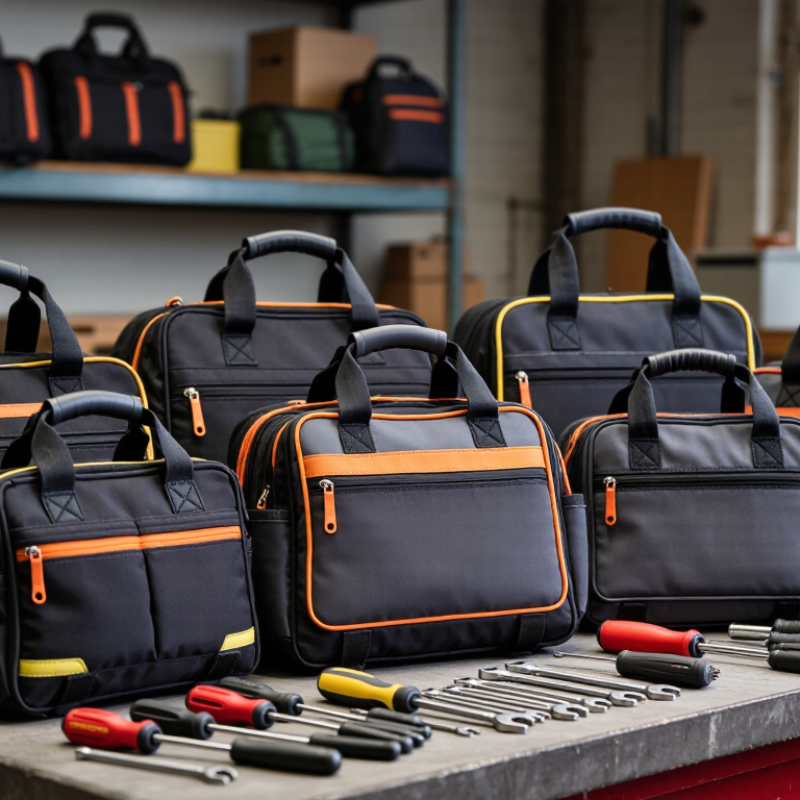
China Top Industrial Tool Bag Suppliers for Global Buyers

What Defines a Top Industrial Tool Bag Supplier in China

A top industrial tool bag supplier in China proves capability through repeatable production, not attractive samples. The WTO reported that China supplied 14.2% of global merchandise exports in 2023. That scale creates options, but it does not guarantee quality. Buyers should examine factory experience, material control, and documented testing. The ISO Survey 2023 recorded more than 1.2 million ISO 9001 certificates worldwide. Certification helps, yet it cannot replace an on-site audit. Ask for batch records, incoming fabric inspections, and corrective-action reports.

Performance appears in small details. Check bar-tack density around handles and shoulder straps. Request load tests that reflect real tools, not empty bags. Inspect zipper cycling, seam strength, abrasion resistance, and water-repellent treatment.

A serious supplier should provide pre-production samples, approved specifications, and traceability from fabric roll to shipment. Independent laboratory testing adds credibility, especially for heavy-duty or outdoor applications. Still, one weakness remains: many buyers compare only unit prices. That approach can hide replacement costs, delays, and inconsistent sizing.

Tips: Ask for a factory video call during production. Compare three consecutive samples, not one. Define acceptable defect levels in writing. Request an AQL inspection plan and retain sealed reference samples. If a supplier avoids raw test data, pause the purchase. A cheaper bag may become an expensive lesson.

Major Industrial Tool Bag Manufacturing Regions and Capabilities

China’s industrial tool bag production is concentrated in several practical manufacturing regions. Zhejiang supports flexible workshops with strong sewing capacity and fast sampling. Ningbo and surrounding cities commonly produce canvas, polyester, and reinforced utility bags. Their factories often handle custom pockets, molded bases, reflective strips, and barcode labels.

Jiangsu is known for organized production lines and stable material sourcing. Manufacturers there often serve construction, maintenance, electrical, and outdoor service applications. They can combine automated cutting with skilled hand assembly. Guangdong offers broader accessory networks, including buckles, zippers, foam padding, and injection-molded components. This helps suppliers develop complex tool backpacks and rolling cases. Fit varies.

Hebei and nearby northern regions also contribute to heavy-duty bag production. Their strengths may include thick fabric, webbing reinforcement, and cost-focused bulk manufacturing. During supplier evaluations, global buyers should inspect stitch density, handle attachment, base abrasion, and zipper performance. A sample should carry realistic weight, not empty packaging. Ask for fabric specifications, inspection records, production capacity, and replacement procedures. These documents improve purchasing reliability.

In practice, no region delivers every capability equally. Some workshops offer excellent sewing but limited testing equipment. Others provide attractive samples but struggle with consistent bulk production. A factory visit, third-party inspection, and pilot order can expose these gaps early. The most dependable sourcing decision balances regional expertise, communication quality, lead time, and measurable quality control.

Key Product Types and Customization Options for Global Buyers

China Top Industrial Tool Bag Suppliers for Global Buyers

Industrial tool bags from China serve different working conditions, not just different price points. Open-top tote bags support quick access on construction sites. Zippered tool cases protect small instruments during transport. Backpack models distribute weight across both shoulders. Rolling bags help technicians move heavier equipment through warehouses.

Global buyers can request practical customization. Common options include 600D or 1680D polyester, reinforced stitching, molded bases, reflective strips, and water-resistant coatings. Interior layouts may hold screwdrivers, meters, cables, or replacement parts. Buyers can also specify dimensions, handle length, zipper type, color, labels, and packaging. A sample should match the expected load, not only the appearance. A beautiful sample can still fail under daily use.

Supplier evaluation needs evidence. Ask for material specifications, stitching photographs, load-test records, and production samples. Confirm whether the stated fabric weight applies to the whole bag or one layer. That detail is easy to miss. Factory visits, video inspections, and independent testing can improve purchasing confidence. Clear drawings reduce production errors, especially when compartments require exact spacing. Minimum order quantities and lead times should be written into the quotation. One practical lesson is simple: adding pockets often increases weight and production cost. Buyers sometimes request every feature, then discover the bag is uncomfortable. Test real tools inside it before approving bulk production. Availability matters more than decoration.

China Top Industrial Tool Bag Suppliers for Global Buyers

Typical carrying capacity by industrial tool bag type, with common customization options for international procurement projects.

Rolling tool bags generally support the highest loads, while tool backpacks and compact waist bags prioritize mobility. Buyers can typically customize fabric denier, colors, compartments, zippers, logos, reflective strips, handles, and packaging.

Quality Standards, Materials, and Production Control

China’s industrial tool bag suppliers increasingly compete on measurable quality, not only low pricing. The ISO Survey of Certifications 2022 recorded 1,265,216 ISO 9001 certificates worldwide. Buyers should request process maps, inspection records, and corrective-action evidence from factories.

Material selection affects service life. Heavy-duty bags often use 600D or 1680D polyester, reinforced stitching, molded bases, and corrosion-resistant hardware. Textile Exchange’s Materials Market Report 2024 estimated global fiber production at 124 million tonnes in 2023. This figure highlights the need to check recycled-content claims through traceable certificates, not marketing language. Abrasion testing, seam strength checks, zipper cycling, and load trials should match the buyer’s working conditions.

Production control needs visible details. A reliable factory separates incoming fabric inspection, cutting, sewing, assembly, and final sampling. ISO 2859-1 provides acceptance-sampling methods, but sampling alone cannot repair weak workmanship. Inspectors should examine bar-tacks at handle joints, uneven thread tension, loose webbing, and sharp edges inside pockets. Small defects matter.

Field feedback is still imperfect. A bag may pass a laboratory load test yet fail after repeated vehicle use, dust exposure, or wet storage. Suppliers should record complaints by batch and revise patterns when failures repeat. Some factories resist this transparency. That is a warning sign.

China Top Industrial Tool Bag Suppliers for Global Buyers - Quality Standards, Materials, and Production Control
Data Dimension Typical Specification Quality or Compliance Reference Production-Control Requirement Buyer Verification Point
Outer Fabric 600D polyester for standard-duty bags; 1680D nylon or polyester for heavy-duty applications Fabric denier and composition should match the approved technical specification and sample Incoming inspection for weave defects, coating uniformity, color, weight, and width Request fabric test reports, production-lot identification, and a retained reference sample
Abrasion Resistance Use a buyer-defined cycle requirement based on intended working conditions ISO 12947-2 or ASTM D3884 may be used for textile abrasion evaluation Test fabric panels and finished-bag high-wear zones such as the base, corners, and handles Confirm test pressure, abrasive material, end point, and pass/fail criteria before mass production
Tensile Strength Set minimum warp and weft strength according to bag size, load, and fabric construction ISO 13934-1 or ASTM D5034 can be used for textile tensile testing Test bulk fabric and investigate any result below the approved specification Review the test direction, specimen size, conditioning method, and laboratory details
Water Resistance Coated polyester, coated nylon, or laminated fabric may be selected for improved water repellency ISO 4920 can evaluate surface wetting; hydrostatic-pressure testing may be specified separately Check coating continuity, seam construction, and performance after folding or abrasion Define whether the requirement is splash resistance, water repellency, or waterproof construction
Base and Reinforcement Double-layer fabric, reinforced synthetic leather, rubberized panels, or molded protective feet Construction should follow the approved drawings and load-bearing requirements Inspect reinforcement placement, stitch density, edge binding, and attachment strength Conduct loaded-drop, standing-load, and base-abrasion tests using a documented protocol
Thread and Stitching High-tenacity polyester thread is commonly used for seams and handle attachment Seam strength and stitch appearance should be defined in the product specification Control stitch density, back-tacking, skipped stitches, loose threads, and seam allowance Inspect stress points, bartacks, handle joints, pocket openings, and zipper ends
Zippers and Hardware Corrosion-resistant metal, molded plastic, or coil zippers; zinc alloy or steel hardware where required Hardware material, finish, dimensions, and function must match the approved sample Perform opening-and-closing checks, puller inspection, dimensional checks, and corrosion screening when specified Verify smooth operation under load and confirm that sharp edges cannot contact the user or tools
Handle and Shoulder Strap Webbing commonly uses polyester or nylon; padding may use EVA foam or polyethylene foam Attachment strength should be established through a product-specific static-load test Use reinforced stitching, bartacks, aligned webbing, and controlled attachment dimensions Test the handle and strap with the specified working load for the specified duration
Colorfastness Set minimum ratings for rubbing, washing, perspiration, and light exposure according to end use ISO 105-X12, ISO 105-C06, and ISO 105-B02 may be selected for relevant assessments Control dye-lot consistency and compare bulk fabric with the approved color standard Approve a physical color standard and define acceptable shade tolerance before ordering
Chemical Compliance Materials, coatings, prints, adhesives, and trims should be screened for market-specific restrictions REACH Regulation (EC) No 1907/2006 and RoHS Directive 2011/65/EU may apply depending on the product and market Maintain supplier declarations, material records, and risk-based laboratory test reports Specify the destination market and require current compliance documentation for relevant components
Dimensional Control Control bag length, width, height, pocket position, handle drop, and internal divider placement Measurements should follow approved drawings with stated tolerances Use calibrated measuring tools and first-piece approval before continuing production Check dimensions when empty and loaded, because fabric construction can change the final shape
Load Capacity Declare a working-load target based on tool weight, carrying method, and intended service environment No universal capacity applies; the buyer should define a product-specific safety margin Perform static-load, carrying, handle, strap, and seam tests on samples from production Do not use a marketing load claim unless the test method, load, duration, and acceptance criteria are documented
Factory Quality System Documented inspection procedures, traceability, corrective action, and equipment calibration ISO 9001 is a recognized quality-management framework when certification is applicable Control incoming materials, first articles, in-process operations, and final inspection Review the certificate scope, internal inspection records, nonconformance reports, and corrective actions
Sampling Plan Use a documented sampling level appropriate to order size and product risk ISO 2859-1 or an equivalent statistically defined sampling procedure may be used Separate critical, major, and minor defects and record the actual inspection quantity Agree on inspection level, AQL values, defect definitions, and release authority before production
Common Acceptance Baseline Buyer-defined limits such as zero critical defects, AQL 2.5 for major defects, and AQL 4.0 for minor defects These values are common commercial examples, not universal legal requirements Apply the same approved criteria to pre-shipment inspection and retained samples Adjust limits for professional, safety-sensitive, or high-load applications
Packaging and Export Marking Individual protective packaging, carton identification, quantity, gross weight, and handling marks Packaging and labeling must comply with destination-country and buyer requirements Verify carton dimensions, count, barcode readability, moisture protection, and pallet stability Approve carton artwork and packing instructions before the first shipment
Production Traceability Link raw materials, work orders, inspection records, and shipment cartons to a production lot Traceability requirements should be included in the purchase specification Use lot numbers, dated records, retained samples, and controlled change procedures Confirm that material substitutions or construction changes require written buyer approval

Note: Test standards and acceptance limits should be selected according to the product design, destination market, intended load, and buyer specification. The references above are commonly used technical frameworks and do not replace applicable laws, certification requirements, or product-specific testing.

How to Evaluate and Select a Reliable Chinese Supplier

China Top Industrial Tool Bag Suppliers for Global Buyers

Selecting a reliable Chinese supplier requires more than comparing online prices. I check factory experience, product specifications, and export communication before discussing volume. A supplier should explain fabric weight, stitching density, zipper quality, load capacity, and packaging methods clearly. Vague answers create costly problems later.

I request samples made from the same materials used in mass production. Then, I test seams, handles, pockets, and abrasion resistance under practical conditions. Photos are useful, but inspection records are stronger evidence. I also review business licenses, quality certifications, production capacity, and traceability documents. A factory that welcomes reasonable inspections usually appears more dependable. Usually, not always.

A polished factory tour can mislead buyers. I once valued a clean showroom too highly and overlooked slow replies from the production team. That was a mistake. Reliable suppliers confirm drawings, tolerances, sample changes, lead times, and corrective actions in writing. Their quotation should separate tooling, packaging, inspection, and shipping costs. Small details matter. Ask who controls final quality and how rejected goods are handled. A trial order can reveal communication gaps before a large commitment. Payment terms, delivery schedules, warranty limits, and dispute procedures should remain clear in the purchase agreement. Supplier selection is not only about capacity; it is about consistent evidence, honest communication, and measurable performance over time.