
A hotel carpet does more than soften a guestroom floor. It absorbs rolling-luggage noise, takes daily foot traffic, and shows dirt near the elevator before anyone mentions it. Choosing well means balancing appearance with cleanability, durability, comfort, and indoor-air considerations. The 2024 J.D. Power North America Hotel Guest Satisfaction Index Study examines guests’ experiences across hotel stays, including room condition and cleanliness. Those findings make flooring a practical guest-experience decision, not just a design detail.
Start with evidence, not a color swatch. The Carpet and Rug Institute’s Green Label Plus program identifies carpet, cushion, and adhesive products tested for low chemical emissions. Ask suppliers for product-specific test documentation and commercial-use performance data. Compare fiber, pile construction, backing, seam placement, and maintenance requirements against your property’s traffic patterns. A busy corridor needs different performance from a quiet suite. Looks matter. So does the cleaning schedule.
Interface founder Ray Anderson often summarized his sustainability philosophy as, “Do well by doing good.” That principle offers a useful lens for Hotel Carpet selection: consider service life, replacement waste, and verified environmental claims alongside the initial price. But a green label cannot predict every stain or installation problem. I would not treat certification as a substitute for a sample installed under real lighting, or for a maintenance trial with your housekeeping team. The right choice should feel comfortable underfoot on opening day and still make sense after carts, coffee, and a full season of guests. Even then, no specification can remove every trade-off.
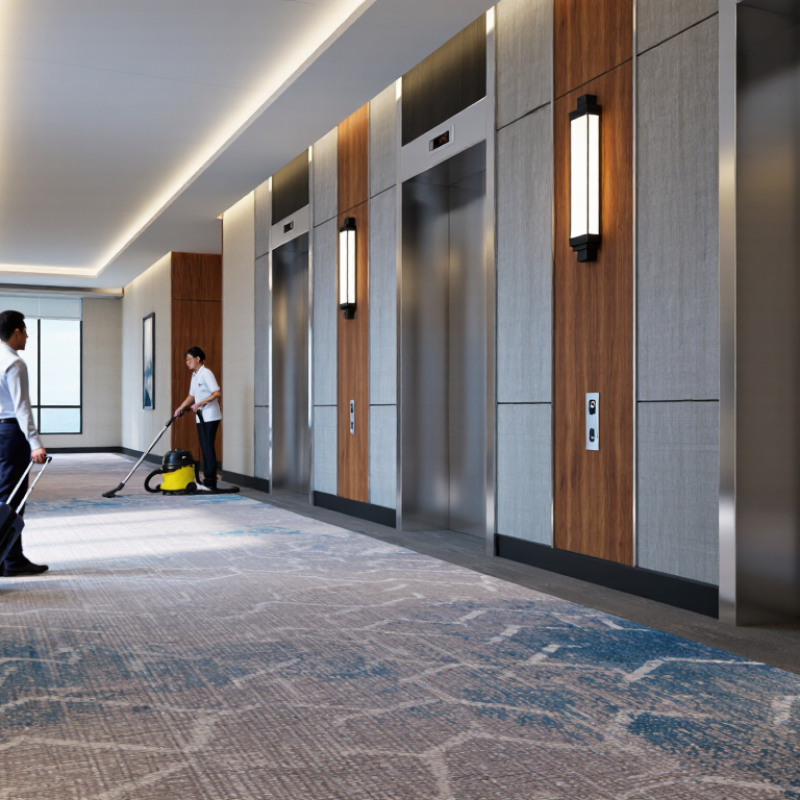
Before selecting hotel carpet, define how each area is used. A guest-room corridor faces rolling suitcases, housekeeping carts, and frequent foot traffic. A quiet lounge has different needs: softer acoustics and a more relaxed feel may matter more. List the busiest zones, expected cleaning routine, and likely sources of moisture or spills. Details help narrow the choices.
Set practical performance targets. Ask suppliers for relevant wear, stain-resistance, and maintenance information, and compare it with the property’s actual conditions. For example, a carpet beside an entrance may need to tolerate damp shoes and regular vacuuming. In guest rooms, consider sound absorption, underfoot comfort, and ease of spot cleaning. Not every area needs the same specification. That can reduce unnecessary expense.
Then define the design requirements with samples viewed under the property’s lighting. A charcoal pattern may hide soil in a corridor, but it can make a narrow space feel darker. Small swatches can also conceal how a repeat looks across a large floor. Check pattern scale, color consistency, and transitions between rooms and public areas. A mock-up helps. Even a careful brief can miss how carts catch a carpet edge or how quickly a pale tone shows wear; revisit those assumptions before finalizing the specification.
| Property Area | Typical Conditions | Functional Requirements | Carpet Options to Consider | Design Considerations | What to Confirm Before Selection |
|---|---|---|---|---|---|
| Guest rooms | Moderate, intermittent foot traffic; guests may move luggage across the floor. | Comfort underfoot, sound absorption, resistance to crushing, and straightforward spot cleaning. | Broadloom or carpet tile with a dense, resilient construction. Nylon is commonly chosen for durability; wool is another option where its appearance and care requirements suit the property. | Use colors and patterns that coordinate with room finishes and help disguise everyday soil between cleanings. | Review the manufacturer’s cleaning instructions, stain-treatment details, backing compatibility, and expected replacement method. |
| Guest corridors | Frequent two-way traffic, rolling luggage, and repeated cleaning. | High resistance to wear, crushing, soil, and visible tracking; seams should be planned for traffic flow. | Dense, low-profile broadloom is often suitable. Carpet tile can simplify localized replacement when access and seam layout are appropriate. | Directional patterns can visually guide movement. A multicolored or patterned design may make tracked soil less conspicuous. | Check construction and wear performance data, installation requirements, rolling-load suitability, and the availability of replacement material. |
| Lobby and reception | Heavy, varied traffic; outdoor moisture and grit may be brought inside. | Durability, cleanability, good appearance retention, and an effective entrance-mat strategy. | Commercial-grade carpet with a dense construction; consider tile in defined zones if individual sections may need replacement. | Coordinate the pattern and color with the lobby’s lighting, furnishings, and flooring transitions. Avoid relying on carpet alone to control tracked-in soil. | Assess entrance exposure, cleaning capacity, transition details, and any applicable fire and building-code requirements. |
| Meeting and conference rooms | Variable traffic, movable chairs, table layouts, and occasional food or drink spills. | Resistance to furniture movement and staining, acoustic comfort, and access for maintenance. | Dense carpet tile or commercial broadloom; select a construction suitable for the expected chair type and traffic. | Choose a pattern that works with room dividers and furniture layouts, and consider how seams or pattern repeats will align. | Confirm suitability for rolling chairs, cleaning methods, chair-protection measures, and the intended installation layout. |
| Restaurants and breakfast areas | Food and beverage spills, frequent cleaning, and movement of chairs and carts. | Stain management, cleanability, and durability; flooring should also meet applicable food-service and safety requirements. | Carpet may be appropriate in selected dining zones, but hard flooring is often easier to clean where spills are frequent. If carpet is used, choose a commercial construction with documented care guidance. | Use flooring transitions to define carpeted areas and avoid placing carpet where routine wet cleaning or food preparation occurs. | Confirm local health, safety, accessibility, and fire-code requirements, plus the cleaning team’s ability to maintain the chosen material. |
| Stairways | Repeated concentrated foot traffic on treads and landings. | Secure installation, durable construction, slip-risk management, and clear visibility of stair edges. | Purpose-specified commercial carpet or a suitable hard-surface system, installed with compatible stair details. | Pattern scale and contrast should not obscure tread edges or create a visually confusing stair surface. | Verify stair-specific installation guidance and applicable building, fire, and accessibility requirements with qualified professionals. |
| All areas | Requirements vary with occupancy, climate, cleaning resources, and renovation plans. | Performance that matches actual traffic, a workable maintenance plan, and suitable indoor-use documentation. | Compare fiber, pile construction, backing, broadloom versus tile format, and any proposed underlay as a complete flooring system. | Evaluate physical samples under the property’s lighting and beside actual wall, furniture, and flooring finishes. | Request technical data, warranty terms, cleaning instructions, fire-test documentation where required, and a sample-based review before ordering. |

© 2025 Acadia Craft. Powered by Integrity Marketing Serving Woodinville, Kirkland, Bellevue & The Greater Seattle Area