
At a busy trade show, a flag must compete with aisle signs, product displays, and people moving in every direction. Outside a café, it may need to catch attention from across a pavement. In both settings, clear design and suitable placement matter more than decoration alone. A Display Flag can help mark an entrance, guide visitors, or make a booth easier to spot. It cannot make an unclear offer compelling.
Industry data supports taking visual communication seriously, while requiring careful interpretation. FedEx Office’s 2012 Signs of Success survey reported that 76% of consumers had entered a store they had never visited because of its signs. The survey also found that 68% had bought a product or service after noticing a sign. These are survey responses, not controlled tests of flags, so they should not be treated as proof that any one flag type will increase sales. Still, they suggest that visible messaging can influence how people notice and approach a business.
The ten flag types in this guide—from feather and teardrop styles to rectangular and blade formats—serve different spaces and practical needs. Height, wind exposure, viewing distance, fabric, and mounting method all affect performance. A tall flag may stand out outdoors but feel awkward in a low-ceiling venue. Small details count. Compare options against the event layout and your message before ordering; even a popular shape can disappoint when it blocks a doorway or carries text that is hard to read.
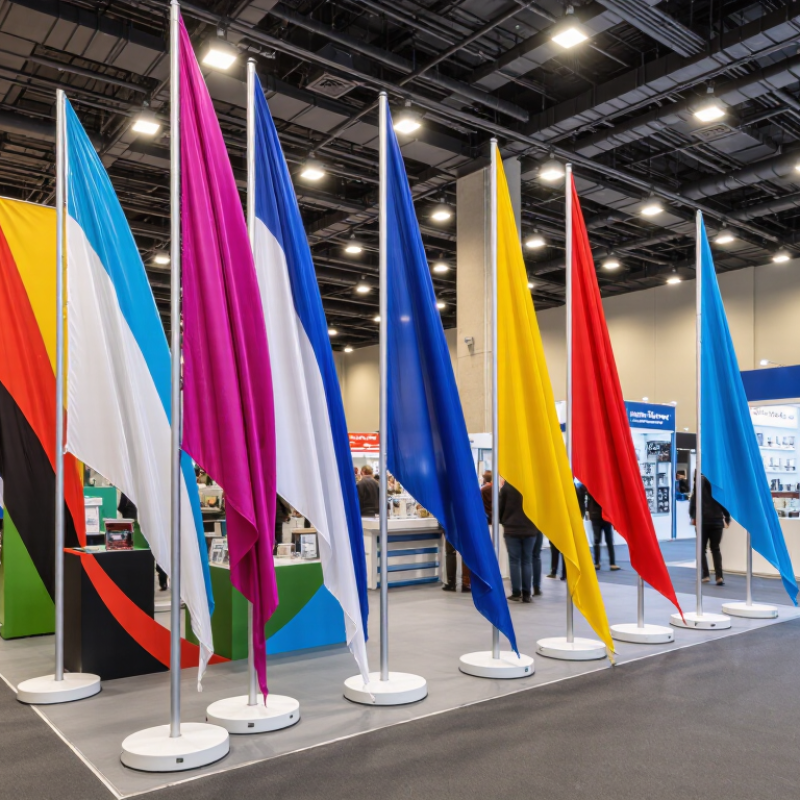
Display flags are lightweight signs made from printed or sewn fabric, mounted on poles, bases, or building fixtures. Common shapes include feather, teardrop, and rectangular designs. Their height and movement help people notice messages from a distance, even in a busy venue. At an outdoor market, a flag near the entrance can mark a stall before visitors reach its table. Inside a conference hall, smaller flags can identify registration areas or guide guests toward a particular zone.
Businesses use display flags for directions, temporary promotions, and simple identification. Event organizers may place them along walkways, near check-in desks, or beside activity spaces. The message works best when it is brief and readable at a glance. A flag crowded with small text often fails in real conditions. Wind, glare, passing crowds, and viewing distance all change how it appears. It matters. Check that the base suits the surface and expected weather, and keep flags clear of walkways and exits. There is no perfect placement; a spot that looks obvious on a floor plan may disappear behind a queue. I have to admit that judging visibility from a mock-up alone can be misleading. A short on-site test, viewed from several approach angles, often reveals what needs adjusting.

Display flags vary most in silhouette, support, and response to wind. Feather and blade flags narrow toward the top, making their messages easy to spot along a sidewalk. Teardrop shapes hold a curved outline, while rectangular and square flags offer more space for broad graphics. Sail, bow, crest, vertical-banner, and handheld styles round out common event and business options. Names can vary between suppliers, so check the actual dimensions, not just the label.
Shape affects more than appearance. A tall feather flag can rise above a crowd, but small lettering may be hard to read from a distance. A rectangle gives text more room, though its loose edge can flap across the design. Wind changes everything. Look at the pole sleeve and tension points: they influence how fabric hangs and turns. A display that looks crisp indoors may twist outdoors, especially in gusts.
Mounting determines where each type works. Ground spikes suit grass or soft soil; cross bases sit on flat floors and often need a weight outdoors. Wall brackets keep flags close to a storefront, while portable bases help at temporary booths. Handheld flags move with people. That motion attracts attention, but can make a message harder to read. A neat setup can still be awkward if the base blocks a walkway or the flag repeatedly folds over itself. Test the display at its actual location, then adjust the height and angle.
Display flags work best when their shape, message, and placement fit the setting. UFI’s 2024 Global Exhibition Barometer reported that exhibition activity in 2023 had recovered to about 98% of 2019 levels. That means busy venues need clear wayfinding, not just more decoration. Ten useful options are feather, teardrop, rectangular, blade, swooper, sail, bowhead, indoor pole, tabletop, and wall-mounted flags. Each serves a different job.
Feather and teardrop flags suit entrances and outdoor queues; their curved profiles remain recognizable from a distance. Rectangular and blade flags provide more space for a short offer or directional arrow. Swooper and sail styles add height, but can feel oversized in narrow walkways. Bowhead flags create a broad, readable panel, while indoor pole flags bring a formal look to lobbies. Tabletop flags mark registration desks, and wall-mounted flags save floor space. Placement matters.
The Out of Home Advertising Association of America’s research with Comscore has examined how outdoor ads prompt digital activity, a useful reminder that visibility can lead people to seek more information. Keep flag copy brief and pair it with a nearby sign or staffed point. Check sightlines at visitor height, then inspect the setup from the entrance. A tall flag may photograph well yet block a smaller sign; that trade-off is easy to miss during planning.
Feather, teardrop, blade, rectangular, sail, pole, handheld, table, banner, and pennant flags each suit different spaces. Their fabric affects how they hang and how long they look crisp. Knitted polyester is lightweight and moves well outdoors, while woven polyester often gives a steadier surface for detailed graphics. Heavy fabric can feel durable, but it may not flutter clearly in light wind. Feel the material before choosing, if possible.
Dye-sublimation printing is common for polyester flags because the color becomes part of the fibers. It works well for bright, full-color designs, though colors can appear different under indoor lighting. Screen printing may suit simpler artwork and larger runs. A small test print helps catch surprises. Check both sides: single-sided flags may show a reversed image through the fabric, while lined or double-sided options improve readability and add weight.
Hardware matters as much as fabric. A feather flag usually needs a flexible pole, ground stake, or weighted base; a rectangular banner may use a straight pole and sleeve. Match the base to the surface. A stake will not help on concrete. Measure the assembled display, including its clearance from doors and walkways. Even careful choices have trade-offs: lightweight setups are easier to move, but can wobble in gusts.
Choosing a display flag starts with the venue, not the catalogue. A feather flag can guide guests along a long walkway, while a compact teardrop style fits beside a registration table. Check ceiling height, viewing distance, and how people enter the space. A flag hidden behind a counter is decoration, not wayfinding.
UFI’s 2024 Global Exhibition Barometer projected average revenue growth of 15% for surveyed exhibition companies in 2024. More activity can mean busier aisles, so prioritize a clear silhouette and a short message. EventTrack research found that 74% of consumers were more likely to buy after engaging with an event experience. That supports making displays easy to notice, though a flag alone cannot guarantee engagement. Use high-contrast colors, readable lettering, and a base suited to the floor surface.
Outdoor sites need extra care. Check the manufacturer’s wind guidance, secure the base, and avoid blocking accessible routes or sightlines. A taller flag may catch attention, but it also catches more wind. Small details matter. Measure the space before ordering, then consider whether the flag will still work when the crowd, lighting, and weather change. My own planning bias would be to choose the largest option; it is worth questioning that instinct.
| Display Flag Type | Shape and Format | Typical Size | Best Suited For | Key Considerations |
|---|---|---|---|---|
| Feather Flag | Tall, curved flag panel on a flexible vertical pole | About 2.5–5 m overall height | Storefronts, outdoor events, entrances, and roadside visibility | Moves readily in a breeze and is visible from a distance. Choose a base suited to the surface and expected wind conditions. |
| Teardrop Flag | Rounded, tapered panel held in shape by a curved pole | About 2–4.5 m overall height | Trade shows, event entrances, patios, and areas with limited space | Its tensioned shape can keep the design readable when there is little wind. The usable print area is narrower than on a rectangular flag. |
| Rectangular (Straight) Flag | Vertical rectangular panel, usually supported along one edge | About 2–5 m overall height; panel proportions vary | Promotional displays, outdoor markets, and locations needing a broad print area | Offers substantial space for text and graphics. The panel may wrap around its pole or move less predictably in light wind. |
| Swooper Flag | Long, narrow panel with a curved or angled top edge | About 3–5 m overall height | Roadside promotions, car parks, and temporary outdoor campaigns | Designed for high visibility and movement. Check overhead clearance and secure the base, especially in exposed locations. |
| Wing Flag | Broad, wing-like panel on a lightweight pole system | About 2–4 m overall height | Exhibition areas, sports events, and outdoor promotional zones | Provides a generous visual area. Its wider profile can catch more wind, so select an appropriate base and follow the system’s wind guidance. |
| Crest Flag | Compact, rounded or shield-like panel on a short pole | About 1.5–3 m overall height | Indoor displays, smaller venues, and locations with restricted headroom | Easy to place in tighter spaces and useful for concise messaging. Its smaller panel is less suited to detailed artwork. |
| Vertical Pole Flag | Rectangular flag attached to a fixed upright pole or mast | Panel commonly about 0.6–1.5 m wide and 1–3 m long | Building grounds, venue approaches, campuses, and permanent outdoor displays | Creates a formal, durable installation. Requires a suitable pole, mounting point, and consideration of local permissions and weather exposure. |
| Handheld Flag | Small rectangular or shaped flag on a short hand-held stick | Panel commonly about 15–30 cm across | Parades, audience participation, processions, and indoor ceremonies | Portable and easy to distribute to attendees. Best for close-range viewing rather than drawing attention across a large venue. |
| Tabletop Flag | Small flag mounted on a compact desk or table stand | Panel commonly about 10–20 cm across; stand usually under 40 cm tall | Registration desks, conference tables, reception areas, and counters | Requires little floor space and works well at seated eye level. Keep it clear of screens, signage, and other tabletop materials. |
| Wall-Mounted Flag | Rectangular flag displayed from a wall bracket or short projecting pole | Panel commonly about 0.6–1.5 m wide | Building entrances, indoor halls, storefront façades, and fixed display areas | Does not require a floor base. Check wall suitability, fixing strength, projection clearance, and any applicable building rules. |
Size note: Dimensions are general market ranges, not fixed standards. Actual flag and pole sizes vary by construction and supplier. For outdoor use, match the base and installation to the surface, location, and expected weather.
Whether you’re a homeowner, builder, or designer, you’ll find that our elegant cabinets create a breathtaking space that evokes positive emotions and encourages lasting memories. We invite you to explore our website to learn more about who we are and how we can help you.
Woodinville | Bellevue | Seattle | Kirkland | California | Berkeley | Walnut Creek | Roseville, CA
© 2025 Acadia Craft. Powered by Integrity Marketing Serving Woodinville, Kirkland, Bellevue & The Greater Seattle Area
