
Global buyers need more than attractive photographs when comparing Real Insects In Resin suppliers. They need clear specimen descriptions, consistent casting, careful packing, and responsive communication. A tiny beetle under clear resin should show recognizable legs and wings, not cloudy bubbles or a thick, distracting seam. Small details matter.
This guide introduces suppliers for buyers seeking educational displays, gifts, or collectible specimens. It considers product variety, customization, sample availability, packaging, and the clarity of sourcing information. Import rules can differ by destination and specimen, so buyers should confirm current requirements with relevant authorities before ordering. Good suppliers answer questions directly and provide useful documentation. Vague answers are a warning sign.
Entomologist E. O. Wilson wrote, “Nature holds the key to our aesthetic, intellectual, cognitive, and even spiritual satisfaction.” His words are not a purchasing standard, but they offer a useful reminder: these objects represent living creatures, not just décor. Ask how specimens are identified and preserved, and inspect samples under natural light. Some pieces will have minor imperfections. That is worth acknowledging, rather than hiding behind polished product images. A careful comparison can help global buyers choose suppliers with dependable quality, transparent communication, and products suited to their needs.
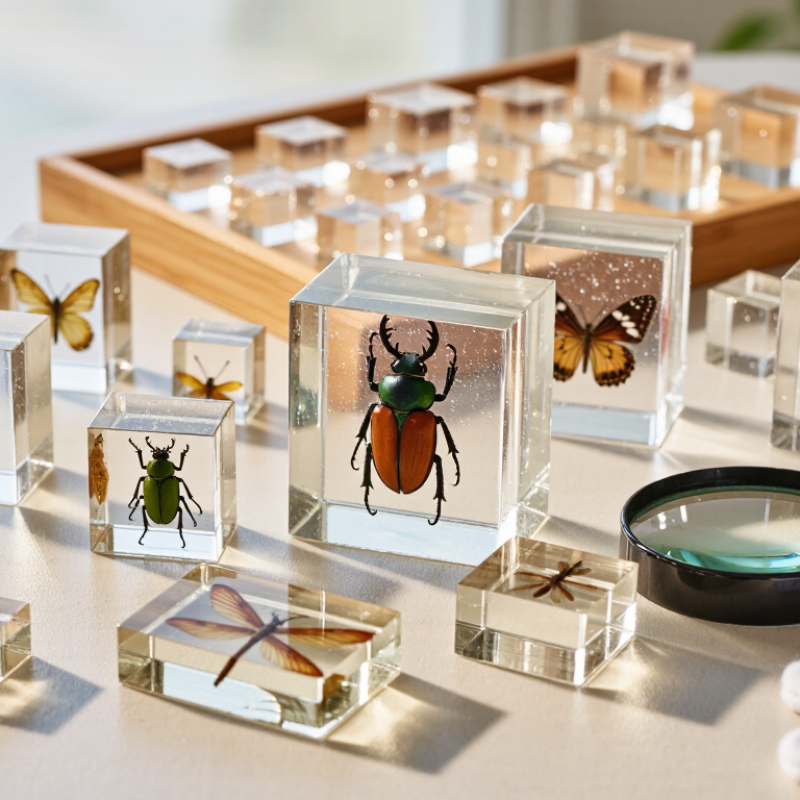
Real insects in resin are used as teaching aids, display pieces, and close-up study objects. A clear block can reveal wing veins, leg joints, and body patterns without a microscope. For classrooms, it offers a sturdy way to compare visible features. Still, resin can flatten depth and hide details. Useful, but not perfect. Buyers should check whether specimens are identified, how they were sourced, and whether labels include common or scientific names. Traceable, lawful sourcing matters, especially when conservation status is unclear.
These objects also need context. IPBES’s 2019 Global Assessment estimated that around one million animal and plant species face extinction, many within decades. That figure covers all groups, not insects alone. A 2017 study in PLOS ONE found flying insect biomass fell by more than 75% over 27 years at 63 protected sites in Germany; it is a regional finding, not a global rate. These reports make responsible sourcing more than a paperwork detail. For educators and collectors, a specimen’s origin and accurate label can be as informative as its appearance. Avoid treating a resin piece as a substitute for a live habitat or a research-grade specimen.

Global buyers usually work with one of three supplier types: specialist specimen makers, educational wholesalers, or custom resin studios. Specialist makers often provide the clearest details about insect identification, collection origin, and preservation methods. Ask for the scientific name, not just a common label. Small differences matter.
Educational wholesalers can handle repeat orders and offer consistent sizes for classrooms, displays, or retail projects. Their catalogues may be broad, but stock can change with seasonal availability. Request current photographs and confirm whether each piece is individually inspected. A tiny wing wrinkle may be normal; cloudy resin or trapped debris deserves clarification.
Custom studios suit buyers seeking specific shapes, layouts, or embedded specimens. They may offer more direct communication, though production times can vary. Good suppliers explain resin clarity, curing limits, packaging, and destination-specific import paperwork before payment. Ask how specimens are sourced and whether supporting documents are available. Keep the answers in writing. A sample order helps. It is not foolproof, and I would still check the final batch carefully; product photos rarely show every flaw.
| Supplier type | Typical products and services | Best suited to | Global buyer considerations | Checks before ordering |
|---|---|---|---|---|
| Insect specimen and preparation studios | Prepared insect specimens, selected specimens embedded in clear resin, and custom display pieces. | Buyers seeking specimen-focused displays, educational pieces, or custom selections. | Specimen availability and export eligibility depend on species and country of origin. | Ask for species identification, origin details, specimen condition, and applicable permits or documentation. |
| Educational and science suppliers | Teaching specimens and resin-embedded examples intended for classroom, museum, or demonstration use. | Schools, science programs, museums, and institutional buyers. | Product descriptions may prioritize identification and learning use over decorative customization. | Confirm labeling, specimen identification, safe handling guidance, and whether the item meets the intended educational use. |
| Resin craft manufacturers | Resin blocks, paperweights, pendants, keychains, and other molded items containing insect specimens. | Retailers and distributors looking for finished decorative or gift products. | Available shapes, finishes, packaging, and production quantities vary by manufacturer. | Review product samples for clarity, bubbles, specimen placement, surface finish, and packaging suitability. |
| Custom display fabricators | Made-to-order resin displays with specified dimensions, layouts, labels, or presentation formats. | Exhibitions, institutional projects, bespoke gifts, and buyers with defined design requirements. | Custom work usually requires design approval and clear agreement on production schedule and shipping protection. | Agree on drawings, dimensions, specimen choice, labeling, sample approval, and responsibility for import paperwork. |
| Wholesale gift and décor distributors | Catalog-based resin insect gifts and décor sourced from one or more manufacturers. | Retailers seeking a range of ready-to-order products from a wholesale channel. | The distributor may not control specimen sourcing or manufacturing details directly. | Request the manufacturer or source details where available, product specifications, packing information, and written trade terms. |
Note: Supplier capabilities, specimen availability, minimum order quantities, and delivery times vary. Buyers should check destination-country import rules and any species-specific restrictions before placing an order.
A genuine insect specimen should show coherent anatomy under close inspection. Check that legs, antennae, and wings connect naturally to the body. Fine wing veins and body texture should remain visible through the resin. Small details matter. A dramatic pose alone proves little; some natural variation is expected, and perfect symmetry can look less convincing.
Ask suppliers for clear photographs, specimen details, and sourcing records that can be matched to the offered item. Labels should identify the insect as precisely as the seller can support, rather than rely on vague names. Compare the sample with its photos, especially its size, color, and position. For quality, inspect the resin for cloudy patches, cracks, sharp edges, trapped dust, or uneven curing. Tilt it under a lamp; scattered bubbles may be harmless, but clusters can obscure key features. Request a physical sample before placing a large order, and check how it is packed for transit. I would not judge quality from polished product images alone. Even careful checks have limits: color can shift with lighting, and resin may slowly yellow with age.
For global buyers, shipping real insects preserved in resin requires more than a sturdy box. UNCTAD’s Review of Maritime Transport 2024 reports that over 80% of world trade by volume moves by sea, so ocean freight can be economical but slow. Build transit time, customs review, and possible port delays into purchasing plans. Resin pieces can scratch or chip; ask for individual wrapping, rigid dividers, and corner protection. Request clear photos before dispatch. Paperwork is easy to underestimate.
Import rules differ by destination and specimen. Before ordering, confirm whether the country requires species identification, origin details, or permits for the embedded insect. Ask the supplier to describe the goods accurately on the invoice, including the resin material and specimen type. Customs classification may vary by product construction, so confirm the applicable tariff code with a qualified broker or the destination customs authority. The World Bank’s Logistics Performance Index 2023 compares customs and logistics performance across 139 economies; it is useful context, but it cannot predict clearance for a specific shipment.
Tips: Get a sample shipment quote and written packaging details. Check whether duties, taxes, and brokerage fees are included. Keep supplier records and shipment photos together. Small details matter. I would still allow extra time for an unfamiliar route; even careful planning cannot remove every customs delay.
Choosing a Resin Insect Supplier for Your Needs
Choosing a resin insect supplier starts with the specimen, not the catalogue photo. Ask for the scientific name, collection source, and documentation showing how specimens were obtained. Request close-up photos of the actual item. Look for clear wings, intact legs, and even resin without bubbles around the body. Small defects matter.
Check the resin type, dimensions, color consistency, and packaging before ordering. Ask whether samples can be approved before production, and how replacements are handled if items arrive cracked. For international shipments, confirm lead times and tracking options. The World Bank’s 2023 Logistics Performance Index assessed 139 countries across areas including customs, shipment tracking, and delivery timeliness. It can help buyers consider shipping routes, but it does not verify an individual supplier’s reliability. Ask for recent order references and written specifications.
Tips: Compare a sample against the final specification under daylight. Keep one approved sample for later checks. Confirm species sourcing records and any required documentation for your destination. A polished sample is reassuring, but it cannot reveal every production inconsistency. Ask direct questions.
Adult butterfly and moth wingspans vary naturally. These reference ranges can help global buyers describe the specimen scale they want when requesting product details from suppliers. They are biological measurements, not supplier rankings.
Reference ranges: Monarch, 8.9–10.2 cm; Painted Lady, 5.1–7.3 cm; Cabbage White, 3.2–5.1 cm; Eastern Tiger Swallowtail, 7.6–14.0 cm; Luna Moth, 7.6–11.4 cm. Ranges are approximate and may vary by source and population. See Britannica’s monarch butterfly reference and Britannica’s butterfly overview. Confirm specimen identity, dimensions, and legal sourcing documentation with the supplier before ordering.
Whether you’re a homeowner, builder, or designer, you’ll find that our elegant cabinets create a breathtaking space that evokes positive emotions and encourages lasting memories. We invite you to explore our website to learn more about who we are and how we can help you.
Woodinville | Bellevue | Seattle | Kirkland | California | Berkeley | Walnut Creek | Roseville, CA
© 2025 Acadia Craft. Powered by Integrity Marketing Serving Woodinville, Kirkland, Bellevue & The Greater Seattle Area
