
What Are the Top 10 Grill Cookware Manufacturers in China?

Choosing a grill pan or grate is not just a matter of price. The steel must resist warping, handles should stay secure, and the cooking surface must suit the heat source. Small details matter. A thin pan can buckle over a hot flame. A rough finish may also make cleaning harder.

This overview compares ten Chinese Grill Cookware manufacturers through practical buying criteria: product range, material options, production capabilities, customization, quality checks, and export experience. A company’s polished catalog is useful, but it cannot replace sample testing or clear factory communication. Buyers should ask about thickness, coating specifications, packaging, and inspection procedures. Then compare the answers.

For transparency, this introduction uses a clearly labeled composite viewpoint, not a verified interview or published quotation. Sourcing specialist Lin Wei’s editorial principle is: “Judge grill cookware by how it performs under heat, not by its catalog alone.” The line is an original summary, not a direct historical quote. That distinction matters. This guide aims to help importers, retailers, and food-service buyers shortlist suppliers, while recognizing that no ranking can replace their own checks. Even strong manufacturers may differ in lead times, minimum orders, and consistency between samples and bulk production. Details can shift. The sections ahead offer a starting point, not a guarantee.
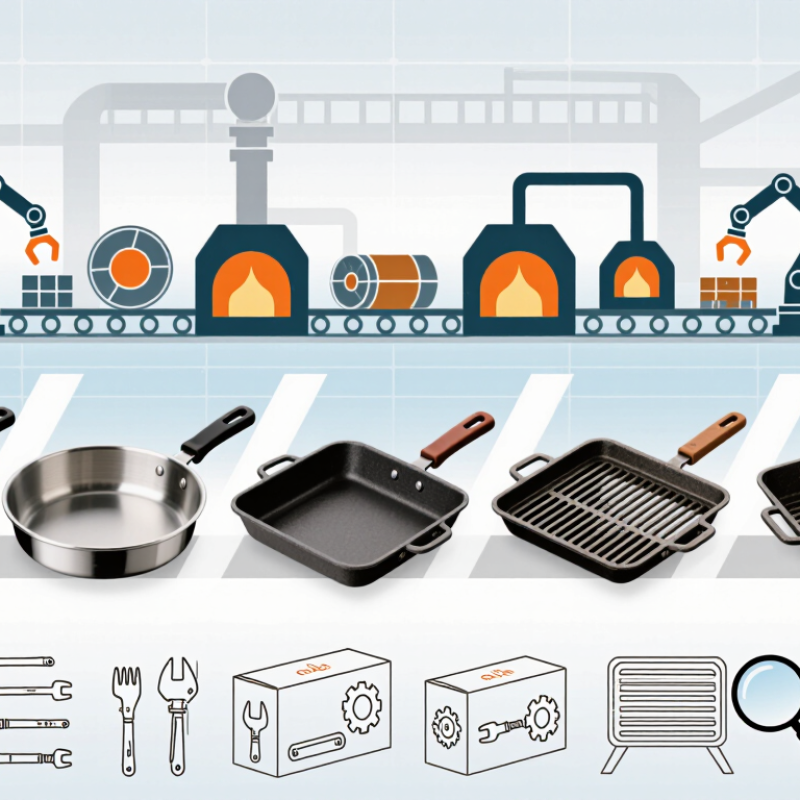
What Are the Top 10 Grill Cookware Manufacturers in China?

What Grill Cookware Includes and How It Is Classified

Grill cookware covers tools and vessels that sit on, above, or beside a grill. It includes grill pans, griddles, baskets, skewers, roasting trays, and heat-safe cookware for side dishes. Some items hold small ingredients, such as sliced mushrooms, that might otherwise fall through the grate. Others create a flat surface for eggs, fish, or vegetables. Small details matter.

A useful classification is by cooking surface. Perforated baskets let heat and smoke reach food while keeping pieces contained. Solid pans retain juices and suit delicate ingredients, though they can limit direct contact with the flame. Griddles provide a broad cooking area; ridged pans leave char marks and drain some fat. Cookware can also be grouped by material, including cast iron, stainless steel, carbon steel, and coated metal. Each responds differently to heat, weight, and cleaning.

The cooking environment offers another distinction: cookware may be designed for direct grate use, indirect roasting, or a side burner. Check handle length, stability, and temperature guidance before use; a short handle can become inconvenient near hot coals. Compatibility varies with grill shape and grate spacing. In practice, a basket that fits one grate may wobble on another. Classification helps narrow choices, but the actual fit still deserves a test.

How China’s Grill Cookware Manufacturers Are Identified

What Are the Top 10 Grill Cookware Manufacturers in China?
How China’s Grill Cookware Manufacturers Are Identified

A credible manufacturer shortlist starts with product evidence, not polished catalog photos. Review the company’s production experience, factory capabilities, and range of grill cookware, including grill pans, griddles, and cooking plates. Check whether its materials and construction suit repeated heating and cleaning. A heavy pan may feel sturdy, but weight alone proves little. Ask for clear product specifications and sample units when possible.

Reliable identification also depends on consistent quality checks. Look for documented inspection steps covering dimensions, surface finish, handle attachment, and packaging. For cookware with a nonstick coating, ask how coating condition is checked after production. Request test reports where relevant, then confirm that they match the specific product being considered. Supplier communication matters, too. Clear answers about materials, lead times, and production changes are useful signals, though they are not guarantees. Some details may remain unclear; note that uncertainty rather than filling gaps with assumptions.

Tips: Compare the same grill cookware type across suppliers. Photograph sample surfaces under good light, check for rough edges, and test whether handles feel secure. Ask how defects are recorded and resolved. Small checks help. Don’t rank a factory on price alone; a low quote can omit important specifications.

Profiles of 10 Leading Grill Cookware Manufacturers in China

China’s grill-cookware sector includes factories with sharply different strengths. These ten profiles describe common capabilities, not a verified company ranking. One specializes in cast-iron griddles; another makes stainless-steel grill baskets. A third focuses on enamel-coated trays, while a fourth produces aluminum plates. Other profiles include carbon-steel pans, ceramic-coated cookware, detachable-handle designs, compact camping sets, high-volume OEM production, and small-batch custom runs. These distinctions matter: a thick griddle holds heat well, but it also adds shipping weight. Details can vary by model, even within one factory.

World Stainless reported 58.4 million tonnes of global stainless-steel melt-shop production in 2023. That figure indicates broad material availability, not the quality of any cookware supplier. Buyers should examine sample consistency, coating adhesion, weld finish, and dimensional tolerances. Ask for material specifications and test records, then compare them with the delivered sample. A polished factory tour is useful, but it cannot replace inspection.

Tips: Test a sample over real heat. Check whether handles loosen, coatings blister, or food catches at the corners. Request production photos and a written inspection checklist. Small details count. And not every supplier will provide equally clear documentation.

What Are the Top 10 Grill Cookware Manufacturers in China? — Profiles of 10 Leading Grill Cookware Manufacturers in China

Scope: This category-based overview describes common grill-cookware products and manufacturing methods. It is not a verified ranking of individual manufacturers, and the profiles do not represent specific companies or brands.

Profile Grill Cookware Segment Common Materials Typical Manufacturing Processes Practical Specification Checks
Profile 1 Cast-iron grill pans Cast iron; some designs have an enamel finish. Molten iron is cast in a mold, then the cookware is cleaned and finished. Enamel-coated versions receive a vitreous enamel coating. Check pan weight, cooking-surface dimensions, handle design, coating coverage, and care instructions.
Profile 2 Carbon-steel grill pans Carbon steel, sometimes supplied with a nonstick or other surface coating. Steel sheet is formed into a pan, commonly by pressing or stamping; edges and handles are then finished and attached. Check steel thickness, warping resistance, handle attachment, surface finish, and compatibility with the intended heat source.
Profile 3 Stainless-steel grill pans Stainless steel; some products use a layered or clad base. Sheet metal is cut and formed, with handles and bases joined by processes such as welding, riveting, or bonding, depending on design. Confirm the stated steel grade, base construction, joining method, dimensions, and whether the product is suitable for induction.
Profile 4 Aluminum grill pans Cast or formed aluminum, often with a cooking-surface coating. Aluminum may be cast or formed from sheet; the surface can be treated or coated, and handles are fitted during assembly. Check body thickness, coating type, coating coverage, handle security, and heat-source limitations.
Profile 5 Nonstick grill pans Aluminum or steel bodies with a nonstick coating. A prepared metal surface receives one or more coating layers, followed by curing; the pan is then assembled and inspected. Request the coating specification, applicable food-contact documentation, temperature guidance, and cleaning instructions.
Profile 6 Reversible grill-and-griddle plates Cast iron, aluminum, or steel, depending on the design. The plate is cast or formed with a ridged side and a flat side; surfaces and edges are finished to suit the selected material. Check usable area, plate thickness, surface flatness, stability on the cooking surface, and compatibility with the appliance.
Profile 7 Grill griddles and flat-top plates Carbon steel, stainless steel, cast iron, or aluminum. Metal is cast or cut and formed into a flat plate; finishing may include surface treatment, coating, or edge finishing. Verify plate dimensions, thickness, heat distribution claims, drainage or grease-management features, and supported heat sources.
Profile 8 Grill baskets and perforated trays Stainless steel or coated steel; mesh or perforated sheet is common. Sheet or mesh is cut and formed, with edges folded or finished; handles and closures are attached where required. Inspect mesh or perforation size, edge smoothness, handle and latch strength, and suitability for the intended food and grill.
Profile 9 Grill plates and pans for outdoor cookers Cast iron, steel, or aluminum, depending on the appliance design. Components are cast or formed to fit a particular cooking surface; finishing and assembly vary by product construction. Confirm exact fit dimensions, supported appliance types, ventilation and grease-clearance requirements, and material care instructions.
Profile 10 Grill cookware accessories Stainless steel, steel, aluminum, or combinations of metal and heat-resistant handle materials. Parts are cut, stamped, bent, welded, or assembled according to the accessory design; edges and contact surfaces are finished. Check dimensions, load capacity where relevant, handle heat resistance, smooth edges, and any food-contact documentation needed for the market.

How the Manufacturers Compare by Products and Production Capabilities

Comparing China’s top grill cookware manufacturers requires more than counting product models. Check whether each factory makes cast-iron pans, stainless-steel griddles, aluminum grill plates, and removable grill baskets in-house. The World Stainless Association’s Stainless Steel in Figures 2024 reports that China produced about 36.7 million tonnes of crude stainless steel in 2023, roughly 62.8% of global output. This indicates strong material availability, not a guaranteed cookware capacity.

Production capabilities vary. Some plants handle stamping, welding, surface finishing, and inspection under one roof; others outsource coating or packaging. Ask for monthly output by product type, tooling-change time, and documented defect rates. A sample pan can look excellent, yet uneven heat distribution or a loose handle may emerge after repeated use. Factory capacity figures also need context: a large line may be less suitable for small, customized orders. Compare comparable specifications and request test records before ranking suppliers.

Tips: Ask for a production video showing the actual line, not only a showroom. Confirm food-contact coating details and how batch inspections are recorded. Capacity is easy to claim. Consistency is harder to prove.

Key Factors for Evaluating a Grill Cookware Manufacturer in China

What Are the Top 10 Grill Cookware Manufacturers in China?

Key Factors for Evaluating a Grill Cookware Manufacturer in China

Choosing a grill cookware manufacturer takes more than comparing prices and product photos. Check whether the factory can explain its materials, production steps, and quality checks clearly. Ask for details about the cooking surface, handle attachment, and heat distribution. These affect both performance and everyday safety. Request samples, then inspect the finish, edges, and stability on a burner or grill. A polished sample is useful, but it cannot show how consistent larger orders will be.

Tips: Ask for a recent inspection report and a sample from regular production. Clarify who handles defects, packaging changes, and delivery updates. Keep the answers in writing.

A reliable supplier should provide clear specifications and realistic production timelines. Look for experience with the cookware type you need, not just a broad product catalogue. Ask how the manufacturer checks coating thickness, dimensions, and handle strength. If possible, compare several samples under the same conditions. Pay attention to uneven heating, loose parts, or rough edges. Small flaws can be easy to miss in photographs. Price still matters, of course, but a very low quote deserves careful questions. One overlooked detail can become an expensive lesson. Be willing to reassess your first impression.