China Top 10 Reformer Pilates Machine Manufacturers
China has become an important manufacturing base for studio and home fitness equipment. Its reformer pilates machine sector now includes large exporters, specialized workshops, and newer technology-focused brands. This guide introduces ten notable Chinese manufacturers for buyers, distributors, studios, and fitness investors.
The selection considers frame construction, carriage smoothness, spring consistency, upholstery, customization, export experience, and after-sales support. Product photographs can be attractive. They are not enough. A serious evaluation should examine weld quality, wood moisture control, aluminum finishing, packaging protection, and replacement-part availability. A reformer may look elegant in a showroom but perform poorly after months of daily classes.
Joseph Pilates wrote, “Physical fitness is the first requisite of happiness.” His principle still matters when assessing modern equipment. A machine should support controlled movement, not merely imitate premium designs. The best suppliers usually provide clear specifications, testing information, and practical communication. Still, no ranking is permanently perfect. Factory capacity, material sourcing, and service quality can change quickly.
Buyers should request samples when possible. They should also test the carriage noise, strap resistance, footbar stability, and spring response. Small details matter. A loose shoulder rest can affect user confidence. Weak packaging can damage a strong machine before installation. This overview offers a useful starting point, not a substitute for direct inspection. Each manufacturer deserves careful comparison against the buyer’s budget, training environment, certification needs, and long-term maintenance expectations.
Definition and Role of Reformer Pilates Machines in the Fitness Industry
Definition and Role of Reformer Pilates Machines in the Fitness Industry
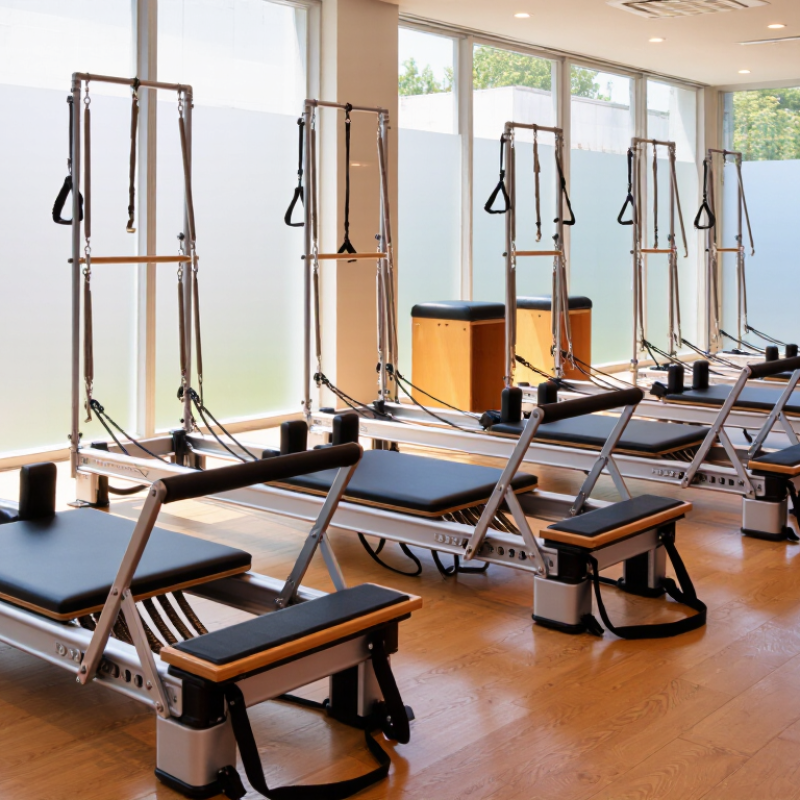
A Reformer Pilates machine is a specialized training platform with a sliding carriage, springs, straps, and adjustable footbar. It creates controlled resistance while supporting precise body movement. Unlike ordinary gym equipment, the Reformer challenges stability, mobility, strength, and breathing at the same time. Its resistance can be changed within seconds, which helps instructors serve beginners, athletes, and older adults in one studio.
In practical sessions, the carriage may move only a few centimeters during footwork. That small movement can reveal poor knee tracking or weak core control. Instructors use spring tension, body position, and repetition speed to improve alignment. The machine also supports low-impact exercise, making it useful for clients managing joint stress under professional guidance. However, it is not a magic solution. Poor instruction can still create strain.
Within the fitness industry, Reformers support private coaching, group classes, rehabilitation-focused programs, and home training. Facilities value their versatility because one machine can produce hundreds of exercise variations. Experienced instructors should assess posture, movement history, and training goals before selecting exercises. Safety depends on clear demonstrations, secure straps, regular equipment checks, and gradual progression. I have found that clients often chase difficult movements too early. That habit deserves more reflection. Better results usually come from controlled tempo, consistent breathing, and honest attention to form.
Key Criteria for Evaluating Chinese Reformer Pilates Machine Manufacturers
China Top 10 Reformer Pilates Machine Manufacturers
Key Criteria for Evaluating Chinese Reformer Pilates Machine Manufacturers
Demand is rising with the wider fitness economy. The Global Wellness Institute reported that physical activity generated about 1.06 trillion dollars globally in 2022. This growth makes supplier selection more important, especially for studios buying several reformers.
Start with factory evidence, not attractive product photos. Request ISO 9001 records, production-flow videos, material certificates, and recent load-test results. Examine welds, pulley alignment, spring consistency, carriage noise, and rail smoothness. Test the sample repeatedly. A reformer should remain stable during fast footwork and controlled jumping. The frame should not twist under practical studio loads. Small defects become expensive after hundreds of daily sessions.
Review quality control at three points: incoming materials assembly final inspection. Ask how the manufacturer records defects and handles replacement parts. Useful documents include drawings, tolerance data, user manuals, and packaging tests. The International Organization for Standardization identifies ISO 9001 as a framework for consistent processes and customer-focused improvement, but certification alone proves little. A polished showroom can mislead. I would also compare two production batches, because one perfect sample may hide uneven manufacturing. Confirm export experience, response times, warranty terms, and spare-part availability in writing. The Global Wellness Institute’s 2024 report projects continued expansion in physical activity, yet rapid growth should not excuse weak testing or vague technical claims.
China’s Top 10 Reformer Pilates Machine Manufacturers by Product Strengths
China Top 10 Reformer Pilates Machine Manufacturers
China’s top ten reformer manufacturers stand out through different product strengths, not one universal ranking. The first focuses on reinforced aluminum frames for busy studios. The second develops compact folding reformers for apartments and small training rooms. The third uses layered hardwood and polished rails for a warmer studio appearance. Another specializes in commercial machines with thicker springs, wider carriages, and replaceable upholstery.
Several manufacturers serve more specific needs. One produces rehabilitation reformers with adjustable resistance and clearer safety markings. Another offers lightweight models for hotels, schools, and mobile instructors. A further supplier emphasizes OEM production, allowing changes to carriage width, footbar height, and color. One company concentrates on smart resistance systems, although digital features should never replace reliable mechanical control. Another competes through practical pricing and simplified structures. The tenth combines Pilates towers, jump boards, boxes, and barrels into complete studio systems.
Product strength requires more than attractive photographs. Buyers should inspect weld quality, pulley movement, spring consistency, weight limits, and long-term replacement support. Ask for factory testing records and sample machines before placing a large order. In my experience, a smooth carriage can hide weak stitching or noisy wheels. That detail matters.
No ranking is flawless. A strong reformer for rehabilitation may feel unsuitable for advanced athletes. Materials, user weight, teaching style, and service distance can change the decision. Independent testing remains wise. Manufacturers should improve documentation, because unclear maintenance instructions still create avoidable problems.
China’s Top 10 Reformer Pilates Machine Manufacturers by Product Strengths
A feature-based benchmark of the product strengths most commonly emphasized in China’s reformer Pilates manufacturing sector. Scores are normalized to 100 and do not represent individual company rankings or brand-specific sales data.
The benchmark highlights the main purchasing considerations for studios, distributors, and commercial fitness projects: structural durability, carriage performance, adjustment flexibility, customization capability, safety, and accessory compatibility.
How to Select the Right Chinese Reformer Pilates Machine Manufacturer
Choosing the right Chinese reformer Pilates machine manufacturer requires more than comparing online prices. Start by checking production experience, engineering capability, and quality control procedures. Request factory photos, material specifications, and recent test records. A serious manufacturer should explain frame strength, carriage movement, spring resistance, and weight limits clearly.
Ask whether the factory performs load testing on every production batch. Inspect the aluminum or steel frame, pulley system, straps, footbar, and upholstery details. Smooth carriage movement matters during repeated studio use. Request samples before placing a large order. Small defects often become expensive after installation. Do not rush.
Communication is another practical test. The supplier should provide accurate drawings, packaging dimensions, shipping terms, and replacement-part policies. Confirm whether manuals and assembly instructions are available in clear English. Check independent audits, export experience, and documented compliance with applicable safety standards. A polished catalog can still hide weak after-sales support. That matters.
Before signing, define inspection points and acceptance criteria in writing. Include surface finish, noise level, alignment, accessories, and packaging protection. A video inspection helps, but it cannot replace physical testing. I would also compare two or three factories using the same questions. The cheapest quotation may omit spare parts, testing, or proper packaging. Reconsider your decision when answers remain vague.