
Choosing a Dancing Water Fountain is not simply a visual decision. It affects engineering, maintenance, visitor safety, operating costs, and long-term site value.
Global buyers may consider musical fountains, floating fountains, interactive splash fountains, laminar jet systems, dry deck fountains, wall fountains, resort fountains, plaza fountains, garden fountains, and customized show fountains. Each type creates a different visitor experience. A musical system may need synchronized lighting, reliable software, and careful acoustic planning. A floating fountain may suit a lake, but wind can distort its spray pattern. Dry deck designs save visible space, yet their underground equipment requires thoughtful drainage and frequent inspection.
Details matter.
During project evaluation, buyers should examine pump capacity, nozzle materials, filtration, water quality, control systems, lighting protection, and local climate conditions. Stainless steel components can improve durability, but they do not remove the need for cleaning. Energy consumption also deserves attention, especially for large installations operating every evening. Supplier experience, installation records, spare-parts support, and clearly documented warranties can reveal more than attractive renderings.
This guide compares ten popular fountain types for international projects. It considers appearance, application, technical demands, maintenance pressure, and purchasing practicality. The ranking is useful, but not absolute. A compact interactive fountain may serve a family plaza better than an expensive musical installation. That conclusion can change with budget, weather, and audience expectations. Some projects still underestimate maintenance. That is a costly lesson. Reliable planning begins with honest site information and a realistic operating plan.
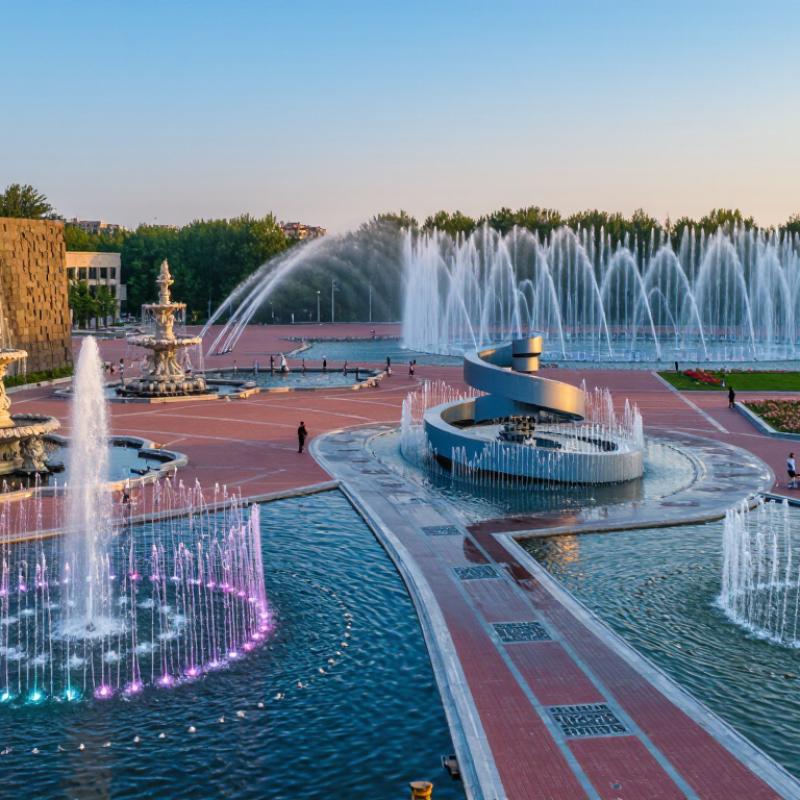
Dancing fountains are best classified by movement, control, installation, and water behavior. This structure helps buyers compare systems beyond appearance. The main types include musical, programmable, interactive, laminar, jet, floating, dry-deck, architectural, solar-assisted, and resort-scale fountains. Each category serves a different site condition. A dry-deck fountain suits plazas because visitors can walk across its surface. A floating fountain fits lakes, but wind can distort its patterns. Laminar jets create clear, glass-like streams, while aerated jets produce brighter, more energetic displays.
Control systems create another important division. Basic programmable fountains follow fixed sequences. Advanced systems synchronize water, lighting, and music through digital controllers. Interactive models respond to pressure sensors, movement, or touch inputs. According to the International Energy Agency, buildings and public facilities remain major electricity users worldwide, making pump efficiency a practical purchasing concern. A visually impressive fountain can still waste energy through oversized pumps and poor scheduling. That is often overlooked.
Location also changes the classification. Urban plazas need durable nozzles, safe drainage, and quiet equipment rooms. Indoor fountains require humidity control and precise splash management. The United Nations reports that 68% of the world’s population may live in urban areas by 2050. This trend supports demand for compact, programmable water features in public spaces. However, market reports do not always use consistent fountain categories. The classification is useful, but not absolute. Buyers should verify flow rate, nozzle material, control compatibility, maintenance access, and local water conditions before selecting a type. Small details matter.

Global buyers can choose from ten practical dancing water fountain types: musical, programmable, floating, interactive, laminar, aerated jet, ring, fan-shaped, mist, and architectural cascade fountains. Musical fountains synchronize water movement with approved audio systems. Programmable models create repeatable patterns for plazas, hotels, and public venues. Floating fountains suit large lakes, while interactive fountains respond to movement or touch-free sensors. Laminar jets produce clear, glass-like streams. Aerated jets create energetic white water and stronger visual impact.
Ring fountains form circular displays around visitors. Fan-shaped jets spread water like moving curtains. Mist fountains provide a softer atmosphere, especially in warm climates.
Architectural cascades combine dancing streams with steps, walls, or terraces. I have found that visual appeal is only one purchasing factor. Pump capacity, nozzle material, filtration, drainage, and electrical protection strongly affect long-term reliability.
Climate changes the decision. Wind can distort tall jets, while hard water may leave deposits on nozzles. Buyers should request flow rates, maintenance schedules, safety documentation, and installation drawings. Local engineers should verify electrical and water-system requirements before construction.
Small test displays often reveal problems that computer images hide. No design is perfect. A spectacular fountain may still consume too much water or require frequent cleaning. Experienced suppliers should explain those weaknesses clearly, not only present attractive effects. A practical choice balances movement, operating cost, visitor safety, and service access.
Top 10 Dancing Water Fountain Types for Global Buyers
Performance depends on water height, movement, lighting, and control accuracy. Musical fountains synchronize jets, LEDs, and sound, but timing requires careful programming. Laminar fountains create clear, glass-like arcs with smooth, stable streams. They look elegant, yet nozzle cleanliness strongly affects their precision. Dancing jet fountains deliver fast vertical movements and dramatic changes in height. Their pumps need responsive frequency control.
Floating fountains suit lakes and large reservoirs, where broad spray patterns improve visibility. Wind can reduce their consistency. Wall fountains use a vertical surface to create sheets, curtains, or narrow streams. They require reliable waterproofing and drainage design. Ring fountains produce circular patterns around public spaces, while dry-deck fountains hide nozzles below the paving. Dry decks need strong filtration and safe, non-slip surfaces. They are attractive, but maintenance access is sometimes underestimated.
Interactive fountains respond to touch, motion, or programmed signals. Their sensors must resist water, dust, and heavy daily use. Fog fountains create soft, low-lying effects through fine mist, though airflow can disperse them quickly. Aerating fountains add oxygen to ponds and improve circulation, but their visual movement may feel less theatrical. I have found that jet height alone does not define quality. Pump efficiency, filtration, noise, control response, and local climate matter more than many buyers expect. Some specifications look impressive on paper. Real performance still needs testing under site conditions.
| Rank | Fountain Type | Primary Water Effect | Typical Water Height | Typical Installation | Control and Show Capability | Wind Performance | Maintenance Profile | Best-Suited Applications |
|---|---|---|---|---|---|---|---|---|
| 1 | Musical Dancing Fountain | Programmable vertical jets, arcs, mist, lighting and synchronized movement. | Approximately 1–20 m, depending on nozzle size, pump capacity and site conditions. | Public plazas, parks, resorts and large outdoor venues; usually requires a dedicated equipment room or vault. | DMX, PLC or show-control systems can synchronize water, RGB/RGBW lighting and music. Supports timed sequences and multiple scenes. | Medium | High; includes nozzles, pumps, filters, lighting, control equipment and water-quality management. | Large-scale landmarks, tourism projects, municipal spaces and entertainment destinations. |
| 2 | Interactive Jet Fountain | Individual ground-level jets that respond to sensors, buttons or programmed user interaction. | Approximately 0.3–3 m for most public interactive installations. | Flush-mounted wet deck or plaza surface with concealed drainage and underground components. | Uses proximity, pressure, infrared or programmable sensors. Jets can react individually or in groups. | Medium to High | High; frequent public contact requires effective filtration, drainage, sanitation and slip-resistant surfaces. | Family attractions, shopping centers, civic plazas, hotels and recreational areas. |
| 3 | Laminar Jet Fountain | Clear, smooth water rods that retain a defined shape over a short distance. | Approximately 0.5–5 m, with shorter throws than turbulent jets. | Indoor or outdoor pools, architectural basins and interactive decks. | Fast on/off control enables jumping arcs, moving water lines and precise choreographed effects. | Medium | Medium to High; clean water and stable flow are important because nozzle precision affects the water shape. | Modern architecture, hotel lobbies, retail spaces, pool features and high-precision displays. |
| 4 | Aerated Jet Fountain | White, oxygenated streams created by mixing air with water at the nozzle. | Approximately 1–8 m for common decorative configurations. | Decorative pools, round basins, public gardens and landscape water features. | Suitable for timed operation, grouped effects and moderate lighting. Produces a bright appearance in daylight. | Medium to High | Medium; generally robust, although mineral deposits and nozzle blockage should be controlled. | Landscape projects, civic gardens, hotel entrances and projects requiring strong visual impact with moderate complexity. |
| 5 | Fan-Shaped Fountain | Flat sheets or fan-like sprays formed by specialized outlets or angled nozzles. | Approximately 1–6 m, depending on the fan nozzle design and flow rate. | Architectural basins, stage backgrounds, entrance features and indoor atriums. | Can create synchronized screens, curtains and layered patterns; lighting is effective from the front or side. | Low to Medium | Medium; fan outlets need regular inspection to maintain an even sheet and prevent streaking. | Architectural focal points, performance stages, entrances and premium interior installations. |
| 6 | Cascade and Waterfall Fountain | Continuous sheets, stepped flows or falling water over edges and textured surfaces. | Approximately 0.3–5 m vertical drop, with flow length determined by the structure. | Retaining walls, architectural facades, stepped landscapes, pools and interior feature walls. | Usually provides steady flow rather than rapid choreography, but can be divided into independently controlled sections. | Medium | Medium; surfaces, weirs, collection troughs and recirculation channels require cleaning to prevent uneven flow. | Hotels, commercial buildings, wellness facilities, gardens and architectural landscapes. |
| 7 | Floating Fountain | Buoyant platform carrying vertical jets, aerators, lights or spray nozzles on a lake or reservoir. | Approximately 2–30 m, depending on platform size, pump capacity and water-body conditions. | Large ponds, lakes, reservoirs and waterfront developments; anchored to maintain position. | Can support programmable water patterns and lighting without major excavation in the water body. | Low to Medium | Medium to High; requires inspection of anchors, floats, electrical protection, intake screens and algae conditions. | Large waterfront attractions, resorts, public lakes and tourism destinations. |
| 8 | Dry Deck Fountain | Vertical jets emerge from a flush paving surface and disappear into concealed drainage grilles or slots. | Approximately 0.5–3 m for public-access installations. | Stone, concrete or tiled plazas with underground tanks, pumps, drains and service access. | Excellent for timed patterns, interactive operation and seasonal use because the area can remain open when the fountain is off. | Medium | High; drainage, waterproofing, filters, grilles, pump access and surface safety require regular attention. | Urban plazas, shopping centers, family areas and multifunctional public spaces. |
| 9 | Mist and Fog Fountain | Fine water droplets that create a mist cloud, atmospheric veil or low-visibility water effect. | Approximately 0.5–5 m, depending on nozzle pressure and ambient conditions. | Gardens, themed attractions, cooling zones, indoor environments and special-effect installations. | Supports lighting, projection and atmospheric programming; water effect is more visual than volumetric. | Low | High; fine nozzles are sensitive to filtration quality, mineral deposits, wind and biological growth. | Theme parks, experiential exhibits, cooling features and indoor or sheltered architectural spaces. |
| 10 | Ring and Multi-Tier Fountain | Concentric jet rings, tiered bowls or multiple elevations producing layered water movement. | Approximately 1–10 m, depending on the number of tiers and central jet configuration. | Formal gardens, round plazas, courtyards, heritage-style landscapes and hotel forecourts. | Offers strong symmetry and coordinated zones; generally less dynamically programmable than a full musical fountain. | Medium to High | Medium; accessible basins and conventional nozzles simplify inspection, but overflow and basin cleaning remain necessary. | Traditional landscapes, civic centers, hotels, resorts and formal architectural settings. |
Choosing among ten dancing water fountain types starts with the site, not the brochure. A compact jet fountain suits a hotel entrance, while a programmable musical display needs open viewing space. Interactive splash systems require non-slip paving and reliable drainage. Rooftop locations add wind, structural load, and maintenance concerns. Measure these conditions before discussing visual effects. I have seen attractive concepts fail because service access was treated as an afterthought. Small detail. Big consequence.
Budget should include installation and lifetime operation.
Laminar jets, aerated sprays, cascading walls, mist fountains, floating units, and dry-deck systems have different equipment demands. Dry decks reduce visible barriers, but their underground machinery may cost more. Request estimates for pumps, filtration, lighting, controls, winter protection, cleaning, and replacement parts. A low purchase price can become expensive after two seasons. Keep a realistic contingency, perhaps 10 to 15 percent, because construction rarely follows the first estimate perfectly.
Usage determines the practical design.
A public plaza needs durable controls and simple daily cleaning. An event venue may value changing programs and synchronized lighting. Residential projects usually need quieter pumps and restrained spray heights. Check water treatment, operating noise, visitor flow, and staff skills before approval. Ask the installer for maintenance records, performance data, and local project references. Test a sample display if possible. The perfect type rarely exists. A slightly less dramatic fountain may serve the location better.
Top 10 Dancing Water Fountain Types for Global Buyers
The ten common types include musical, laminar, jet, interactive, floating, dry-deck, wall, cascade, mist, and LED programmable fountains. Each design needs different pumps, nozzles, lighting systems, and control equipment. Musical fountains require accurate programming and strong electrical protection. Interactive models need slip-resistant surfaces and carefully positioned sensors. Dry-deck systems hide drainage channels below paving, so access panels must remain easy to open.
Installation starts with a reliable foundation and correctly sized drainage. Engineers should check water depth, wind exposure, soil conditions, and nearby electrical routes. A fountain may look elegant in a showroom but behave differently outdoors. Test spray height before final paving. Small alignment errors can create wet walkways.
Maintenance should include regular filter cleaning, nozzle inspection, water-quality testing, and pump checks. Hard water can leave white deposits around narrow nozzles. Cold climates also require pipe drainage and winter protection. International buyers should confirm voltage, frequency, control compatibility, corrosion resistance, packing methods, and spare-part availability. Request drawings, wiring diagrams, test videos, installation manuals, and inspection records. Import duties, delivery terms, local certifications, and after-sales support can change the actual project cost. A low purchase price may become expensive later. This is easy to underestimate.
These indicative planning benchmarks compare common fountain configurations for international purchasing. Installation time is measured in working days, annual maintenance is estimated in labor hours, and packed equipment volume excludes the basin, civil works, and local utility infrastructure. Actual figures vary with fountain size, water treatment requirements, control systems, climate, and site conditions.
Whether you’re a homeowner, builder, or designer, you’ll find that our elegant cabinets create a breathtaking space that evokes positive emotions and encourages lasting memories. We invite you to explore our website to learn more about who we are and how we can help you.
Woodinville | Bellevue | Seattle | Kirkland | California | Berkeley | Walnut Creek | Roseville, CA
© 2025 Acadia Craft. Powered by Integrity Marketing Serving Woodinville, Kirkland, Bellevue & The Greater Seattle Area
