What Is a Stainless Steel Bowl Set?
A Stainless Steel Bowl Set is a group of matching bowls made from corrosion-resistant steel alloys. The set may include two, three, or more sizes for mixing, serving, storing, or preparing food. A small bowl can hold chopped herbs, while a larger one may contain dough, salad, or batter.
Material choice matters. Many household sets use 304 stainless steel, often called 18/8 stainless steel. It offers strong corrosion resistance and handles daily kitchen use well. Some premium sets use 316 stainless steel, which provides greater resistance in demanding environments. However, grade labels should be checked carefully. Marketing descriptions are not always precise.
Stainless steel specialist Harold M. Cobb, author of The History of Stainless Steel, explains a useful principle: “Stainless steel is a family of alloys, not one identical material.” That idea helps readers understand why bowls can look similar but perform differently. Thickness, rim design, weight, and surface finishing also affect practical quality.
Good bowls should sit steadily on a counter. A rolled rim feels smoother in the hand. A brushed surface can hide small scratches. Nesting designs save cupboard space. They usually clean easily, but strong salt, acidic residue, or harsh cleaners can leave marks when ignored.
The answer is not completely simple.
A Stainless Steel Bowl Set is not automatically perfect because it is stainless steel. Some bowls may slide during vigorous mixing. Others may dent after a hard fall. Handles, non-slip bases, and tight lids can improve convenience, but they may complicate cleaning. The best set balances alloy quality, useful sizes, safe construction, and the cook’s actual habits.
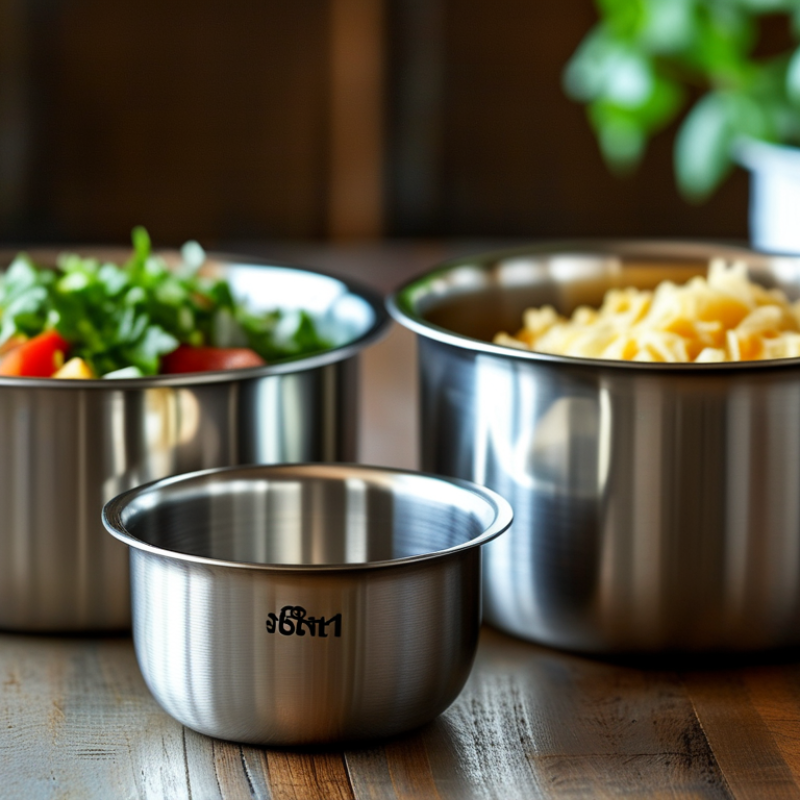
Definition and Components of a Stainless Steel Bowl Set
A stainless steel bowl set is a group of matching bowls made from corrosion-resistant steel. The bowls usually come in several sizes for mixing, washing, serving, and food preparation. Their shared material gives the set a consistent appearance and practical durability. Simple, but useful. Unlike glass, stainless steel is less likely to shatter during busy kitchen work. It also resists stains, odors, and many common food acids, although it is not completely rustproof.
The main components are nesting bowls, rolled rims, and stable bases. A typical set may contain three to six bowls, ranging from a small portion bowl to a large mixing bowl. Nesting designs save cabinet space. Some sets add tight-fitting lids, a colander, or measurement markings. These extras are not universal, so the product description deserves careful reading. Labels such as 18/8 or 18/10 generally describe the chromium and nickel content of the steel. They can indicate useful quality information, but they do not explain every detail of construction.
In practical use, I look for a bowl that sits firmly while whisking eggs or kneading dough. A thin base may slide across a wet counter. That weakness is easy to overlook. I once assumed heavier steel always meant better performance, but balance and rim design mattered more. After washing, drying the bowls prevents water spots. Dishwasher use may be suitable, yet care instructions should still be checked. Even a well-made set can develop scratches when metal tools are used aggressively.
What Is a Stainless Steel Bowl Set?
A stainless steel bowl set is a group of nesting bowls made from corrosion-resistant stainless steel. Sets commonly include several sizes for mixing, whisking, preparing, and serving food.
The chart shows typical bowl capacities used in household and food-preparation sets. Capacities are converted from U.S. liquid quarts using 1 U.S. quart = 0.946 liters.
Bowl Sizes, Capacities, and Nesting Ratios for Kitchen Applications
A stainless steel bowl set usually contains several bowls in graduated sizes. The sizes support preparation, mixing, serving, and storage. Typical capacities range from 0.5 liters for spices and small portions to 5 liters for dough or salad. A practical set often includes 0.75, 1.5, 2.5, 4, and 5-liter bowls.
Capacity can be misleading. Manufacturers may measure to the rim, while kitchen users need safe working space. I leave at least one-third of the bowl empty when whisking or tossing ingredients. This prevents splashing and gives a mixer room to move. The smallest bowl suits chopped garlic, sauces, or separated eggs. Medium bowls handle batters, vegetables, and marinades. The largest bowl works better for bread dough or family-sized salads.
Nesting ratio describes how efficiently the bowls fit together. A useful set often increases diameter by roughly 15 to 25 percent between neighboring bowls. Each bowl should rest securely without wedging tightly. The full stack should remain stable on a shelf. Too little spacing wastes storage, while too much spacing reduces capacity efficiency. I have found that height matters as much as diameter. A narrow base can make a large bowl feel unstable. This is easy to overlook. Bowl dimensions should match actual cabinet depth, not just the listed capacity. Small errors matter.
Food-Safety Standards: FDA 21 CFR and ASTM A240 Requirements
What Is a Stainless Steel Bowl Set?
A stainless steel bowl set usually includes several food-preparation bowls with different capacities. Common details include rolled rims, nesting shapes, and smooth inner surfaces. The steel should resist rust, staining, and repeated washing. However, appearance alone cannot prove food-contact safety. A shiny bowl may still have poor material documentation or rough forming marks.
FDA 21 CFR does not provide one universal rule for every stainless steel bowl. Compliance depends on the material, intended food contact, manufacturing process, and applicable regulatory provisions. Manufacturers should identify the relevant FDA requirements and retain supporting records. These may include material composition, supplier declarations, processing information, and testing when needed. The bowl should not release harmful substances into food during normal use. That point matters.
ASTM A240 covers stainless steel plate, sheet, and strip, including chemical composition and mechanical properties. It can help verify the steel grade used to make a bowl. Yet ASTM A240 certification alone does not approve the finished product for food contact. Forming, welding, polishing, cleaning, and surface condition also require attention. A practical inspection should check the rim for cracks, the interior for pits, and the surface for trapped residue. I once viewed a material certificate as complete proof; that assumption was too simple. Documentation must connect the raw steel to the finished bowl. Suppliers should explain grade, thickness, testing, and intended food-use conditions clearly.