2026 Top Kitchen Cabinet Showroom Suppliers for Global Buyers

Global kitchen design is moving toward smarter storage, durable finishes, and more transparent sourcing. The 2024 Houzz U.S. Kitchen Trends Study reports that homeowners continue investing in functional upgrades, especially improved storage and customized cabinetry. Meanwhile, Grand View Research identifies renovation activity, urban housing, and modular furniture demand as major kitchen cabinet market drivers. These signals matter to international buyers. A cabinet showroom must now demonstrate more than attractive doors.

The 2026 Kitchen Cabinet Showroom supplier landscape should be evaluated through factory experience, product consistency, and documented compliance. Buyers need to inspect cabinet samples, edge finishing, hinge performance, packaging, and moisture resistance. Small details matter. A soft-close drawer should operate smoothly after repeated testing, not only during a showroom visit. Reports from the Forest Stewardship Council and industry certification bodies also reinforce the importance of responsible wood sourcing and traceable materials. Depending on the destination market, buyers may need evidence related to formaldehyde emissions, fire performance, labeling, and chemical restrictions.

No single supplier fits every country or project. Public market reports often combine different cabinet categories, making direct comparisons imperfect. That limitation deserves attention. The strongest 2026 candidates should therefore provide clear specifications, realistic lead times, production references, and responsive after-sales support. Certifications can support trust, but they do not replace factory audits or sample approval. Experience suggests that the cheapest quotation may become expensive after installation problems, damaged panels, or inconsistent color batches. Reliable suppliers explain these risks openly. They also accept reasonable inspection procedures before shipment. That is where professional judgment begins.
2026 Top Kitchen Cabinet Showroom Suppliers for Global Buyers

What Defines a Kitchen Cabinet Showroom Supplier in 2026

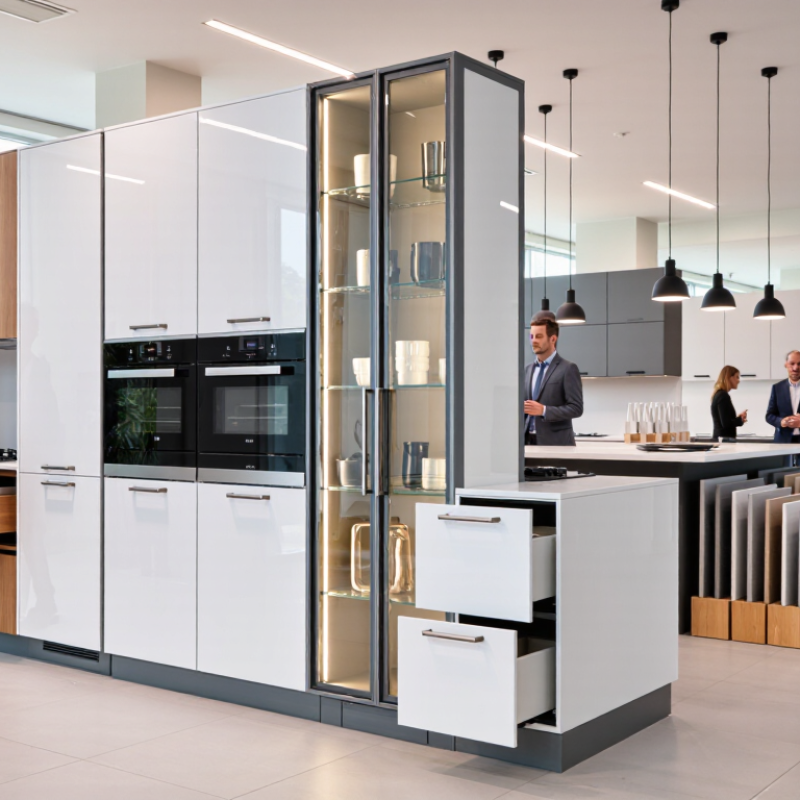
A kitchen cabinet showroom supplier in 2026 must offer more than attractive displays. Buyers need evidence that showroom finishes match shipped products. Experienced suppliers provide full-size door samples, hinge demonstrations, drawer load tests, and clear material specifications. A cabinet should feel stable when opened, not merely look impressive under bright lighting.

Professional suppliers also understand project conditions. They ask about room dimensions, humidity, installation access, and local building requirements before recommending a range. Detailed drawings, digital room plans, and accurate packing lists reduce costly surprises. Reliable teams explain lead times honestly, including possible delays caused by custom colors or replacement parts. Fast replies help, but useful replies matter more.

Sustainability now requires proof, not slogans. Suppliers should identify board composition, coating systems, packaging methods, and responsible material documentation. They should also maintain quality records and provide installation guidance for different markets. After-sales support must include replacement panels, hardware identification, and practical troubleshooting. Small details reveal experience.

No supplier gets every detail right. A showroom may display excellent craftsmanship but provide weak technical files. Another may offer strong documentation but limited design flexibility. Buyers should inspect both sides before committing. A careful supplier welcomes factory audits, sample approval, and staged quality checks. That openness builds authority through verifiable practice, not polished claims.
2026 GLOBAL BUYER BENCHMARK
2026 Top Kitchen Cabinet Showroom Suppliers for Global Buyers - What Defines a Kitchen Cabinet Showroom Supplier in 2026
A practical, evidence-based comparison framework for evaluating showroom-oriented kitchen cabinet suppliers without relying on company or brand rankings.
Evaluation Dimension 2026 Buyer Benchmark Why It Matters to Showroom Buyers Verification Evidence to Request
Product configuration Modular cabinet system with multiple widths, heights, depths, door styles, finishes, and storage accessories. A showroom needs enough configuration depth to serve standard projects and reduce costly one-off engineering. Current catalog, technical drawings, sample-room layout, configuration rules, and change-control procedure.
Dimensional accuracy Published product tolerances, repeatable drilling patterns, and documented inspection points for panels, doors, and carcasses. Accurate components simplify installation and help showroom displays match delivered kitchens. Inspection plan, sampling method, measurement records, approved drawings, and a pre-shipment inspection report.
Material transparency Clear disclosure of board type, thickness, veneer or laminate construction, edge treatment, adhesive system, and hardware specifications. Transparent specifications support accurate quotations, product claims, and replacement-part planning. Bill of materials, technical data sheets, material declarations, and batch traceability records.
Indoor-air compliance For North American projects, verify compliance with applicable formaldehyde-emission requirements under TSCA Title VI or CARB Phase 2; for European projects, request relevant emissions test documentation such as EN 717-1 results where applicable. Cabinet panels and adhesives can affect indoor air quality and market access. Test reports, certificates, product scope, laboratory details, and validity dates matched to the supplied materials.
Safety and performance testing Testing appropriate to the target market for strength, durability, stability, and domestic kitchen furniture safety; European projects may reference EN 14749 where applicable. Verified performance reduces installation failures, customer complaints, and warranty exposure. Independent laboratory reports, test methods, product samples, load ratings, and corrective-action records.
Sustainable sourcing Documented chain-of-custody or responsible-sourcing evidence when certified wood claims are made; no unverified environmental claims. Global buyers increasingly need credible environmental documentation for tenders, green-building projects, and retailer audits. Certificate number, product scope, claim rules, supplier list, recycled-content evidence, and audit status.
Showroom support Display samples, finish chips, door samples, updated price files, installation guides, digital assets, and replacement-sample availability. A showroom sells through touch, comparison, and visualization; outdated samples can create quotation disputes. Sample policy, display-kit pricing, replenishment lead time, image library, CAD or 3D files, and training plan.
Digital specification capability Structured product data, downloadable technical files, revision control, and compatibility information for design and quotation workflows. Accurate digital data speeds design, reduces manual errors, and supports multi-location sales teams. Data templates, CAD/BIM files, version history, API or portal access, and data-update schedule.
Order flexibility Clearly defined minimum order quantities, mixed-container rules, sample-order terms, spare-part ordering, and customization limits. Showrooms need to test demand and replenish popular configurations without excessive inventory risk. Official quotation, minimum-order schedule, sample invoice, spare-parts list, and customization matrix.
Lead-time management Separate quoted lead times for samples, standard production, custom production, consolidation, and international transit. Separating production from transport time gives buyers a more realistic project schedule. Capacity plan, order milestone calendar, historical on-time data, shipment records, and escalation process.
Export and packaging readiness Export-ready packaging, moisture protection, part labeling, carton-level packing lists, container loading plan, and shipment documentation. Well-labeled, protected components reduce damage, installation delays, and customs-document errors. Packaging specification, drop or compression test evidence where relevant, packing list, commercial invoice, and origin documents.
Quality management Documented quality system, incoming-material checks, in-process inspection, final inspection, nonconformance control, and corrective action. A repeatable system is more reliable than a single successful sample order. Quality manual, inspection checklist, defect classification, corrective-action report, and audit results. ISO 9001 certification may be requested but should be verified for scope and validity.
Warranty and service Written warranty terms covering scope, exclusions, claim evidence, response time, replacement parts, and responsibility for freight or labor. Service quality directly affects the showroom’s reputation after installation. Warranty document, claim form, service-level target, spare-parts policy, and anonymized claim-resolution examples.
Commercial and compliance risk Transparent Incoterms® 2020 quotation, payment milestones, insurance responsibilities, sanctions screening, product-liability coverage, and contract jurisdiction. Clear commercial terms reduce landed-cost surprises and cross-border dispute risk. Signed quotation, sales contract, insurance certificate, business registration, banking verification, and compliance declarations.
Buyer note: Certification and test requirements depend on the destination market, product construction, installation environment, and applicable local law. Buyers should verify the current scope, issuing laboratory, validity period, and exact product model before making a compliance or sustainability claim.
Reference standards and regulatory terms used in this framework: TSCA Title VI, CARB Phase 2, EN 717-1, EN 14749, ISO 9001, and Incoterms® 2020. These references are evaluation points rather than endorsements of any supplier or brand.

Major Supplier Regions and Showroom Business Models

Global kitchen cabinet suppliers are concentrated in several practical manufacturing regions. China and Vietnam often support large-volume projects with flexible finishes and competitive pricing. Italy and Germany are known for refined engineering, precise hardware, and strict production controls. Poland and Turkey serve many European and Middle Eastern buyers with shorter regional delivery routes. North American suppliers commonly focus on local installation networks, replacement parts, and project service.

Showroom business models differ as much as production regions. A manufacturer-owned showroom usually displays complete kitchens, working drawers, hinge systems, and material samples. It helps buyers verify quality before placing container-scale orders. Distributor showrooms offer broader selections but may add handling costs and longer communication chains. Hybrid showrooms combine physical displays with digital catalogs, video inspections, and online quotations. Appointment-only spaces can reduce operating costs. Trade-only rooms may provide sharper pricing for contractors and developers.

Buyers should inspect more than attractive doors. Open several drawers, check edge finishing, and compare cabinet dimensions against installation drawings. Ask for sample panels, packing photographs, warranty terms, and realistic lead times. Confirm whether the showroom controls manufacturing or only resells products. That distinction affects problem-solving after delivery. Regional strengths are not absolute. A low-cost supplier may require more inspection, while a premium showroom may still miss deadlines. I have found that clear documentation often matters more than a polished display. Mistakes still happen. Reliable suppliers explain them early and record corrective actions.

2026 Top Kitchen Cabinet Showroom Suppliers for Global Buyers

Major Supplier Regions and Showroom Business Models

East Asia and Europe remain the largest sourcing regions for wooden kitchen furniture, followed by Southeast Asia and North America. Common showroom models include manufacturer-owned showrooms, authorized distributor showrooms, project-focused studios, and digital-first sample centers. Regional export values are rounded estimates based on public UN Comtrade trade classifications for HS 940340.

How to Evaluate Cabinet Quality, Design, and Customization

For global buyers, cabinet quality starts with evidence, not showroom lighting. Inspect a door sample under natural light. Check panel thickness, edge-banding, hinge alignment, drawer movement, and finish consistency. Ask for moisture resistance data and independent testing, where available. The 2024 Houzz U.S. Kitchen Trends Study reported that 76% of renovating homeowners upgraded their cabinets. That demand makes quality control more important, especially for humid shipping routes and frequent temperature changes. A beautiful finish can still hide weak joints.

Design evaluation should connect appearance with daily use. Review full-room drawings, appliance clearances, lighting positions, and storage access. The National Kitchen and Bath Association’s 2024 design research continues to show strong interest in functional storage, concealed organization, and durable surfaces. Do not accept attractive renderings alone. Confirm the actual material, sheen, color code, and replacement process. I have seen small filler panels create large installation problems. That detail deserves more attention.

Tips: Request a physical sample, not only digital images. Test drawers with weight. Ask how custom sizes are priced. Confirm tolerances in millimeters, packaging standards, installation drawings, and warranty exclusions. Compare two or three suppliers using the same specification sheet. Customization should include unusual wall angles, integrated appliances, accessibility needs, and regional hardware preferences. Some suppliers promise “fully customized” designs but offer only limited width changes. That is a useful warning. Document every revision before production.

International Standards, Certifications, and Export Capabilities

For global kitchen cabinet buyers, certification is more than a logo on a brochure. It should support safer materials, stable production, and predictable exports. The ISO Survey 2022 recorded 1,265,216 ISO 9001 certificates worldwide. This shows how widely quality management systems are used. However, certification alone cannot prove every cabinet is well made. Buyers should request current certificates, audit scopes, and production records.

Export-ready suppliers should understand EN 14749, ANSI/KCMA A161.1, CARB Phase 2, and TSCA Title VI requirements. These standards address furniture safety, structural performance, and formaldehyde emissions. The World Bank’s Logistics Performance Index 2023 also evaluates customs, infrastructure, shipment tracking, and delivery reliability. Ask for carton drop-test results, moisture-control procedures, and loading photographs. A 40-foot container should show clear labeling, protected corners, and stable pallet placement. Small details matter.

Tips: Check certification numbers independently. Match them with the legal factory name and address. Request recent third-party test reports. Confirm Incoterms 2020, HS codes, lead times, and replacement policies in writing. A supplier may have strong paperwork but weak communication. That risk deserves honest attention. Product samples should be inspected before large orders.

A Step-by-Step Guide to Comparing Global Suppliers

Comparing Global Kitchen Cabinet Showroom Suppliers: A Step-by-Step Guide

Start with product evidence, not showroom photography. Request door samples, board specifications, edge details, hardware load ratings, and moisture-resistance test results. Compare the same cabinet layout across suppliers. This exposes differences in usable storage, finish consistency, and construction quality. The 2024 Houzz U.S. Kitchen Trends Study shows that homeowners continue investing heavily in kitchen renovations, making durability a practical purchasing issue.

Check manufacturing experience next. Ask for factory audit records, quality-control checkpoints, annual capacity, and recent export references. A supplier should explain how it handles color variation, replacement parts, and damaged cartons. Ask for a sample inspection report. Small omissions matter. The 2023 World Bank Logistics Performance Index highlights customs, tracking, and delivery reliability as major supply-chain performance factors. Therefore, compare landed cost, not only the factory quotation. Include packaging, insurance, duties, port charges, installation support, and warranty response time.

Then test communication under pressure. Send identical technical questions to three suppliers and record response speed, accuracy, and ownership of mistakes. Require drawings with dimensions, tolerances, materials, and hardware codes before approving production. Review payment milestones carefully, preferably tying final payment to inspection evidence. Harvard’s Joint Center for Housing Studies projected U.S. homeowner remodeling expenditure to reach about 509 billion dollars in 2025, indicating strong demand but also greater pressure on lead times. One weakness remains: showroom displays rarely reveal long-term service quality. Speak with commercial buyers who completed installations at least twelve months ago. Their complaints may be more useful than polished brochures.